OTTAWA – Liberal Leader Bob Rae made the following statement today on Bill C-10, the omnibus crime bill:
“I want to salute the hard work of our friend and colleague Irwin Cotler, the Liberal Justice and Human Rights critic, who has worked tirelessly to try to improve this legislation for the benefit of all Canadians. He introduced amendments to get tougher on terrorists. He introduced amendments to incorporate the needs and views of Quebec. Unfortunately, his expert advice and work were almost completely ignored – the only exception being when the Conservatives tried to re-introduce Mr. Cotler’s sensible amendments on terrorism as their own, despite having first rejected them without explanation.
Mr. Cotler continued:
“The Conservatives’ bundling together of 9 bills that warranted independent discussion, their shutting down of debate in committee, and their rejection of all amendments while arrogantly labeling others as supporters of criminals and not victims, undermines Parliament and democratic process. They have rammed through the House of Commons a law and order agenda that is poorly thought-out, rushed and demonstrates the Conservative commitment to governing by ideology instead of facts and evidence.
This bill will impose mandatory minimums that will turn young offenders into hardened criminals. It fails the mentally ill, aboriginal people, visible minorities and the poor. It repeats the mistakes of failed, expensive and discredited American crime policy. Police and prisons officials from states like Texas are telling Mr. Harper very clearly: We tried what you are doing but it drained the public coffers and made our communities less safe. Do not go down our failed path.
At the end of the day we will have more crime, less justice, skyrocketing costs, prison overcrowding, less rehabilitation for the offenders, less protection for victims and less protection for the public. Liberals are committed to pursuing a crime and justice approach that is evidence-based, cost effective and focused on preventing crime and victimization.”
Please also visitIt Could Get Worse for different ways you can still help "Kill the Bill".
The disappointment in the MP's who voted for this "Everything plus the kitchen sink" Bill has me cranky, up late, and tired. *sigh*.......
I left a comment on the National Post website after reading the brilliant article "Canada's inhumane prison plan" by Conrad Black in todays edition. I've extended it here though to add even more links and info.
I'm thankful that Mr. Black has addressed the Consevative "Tough on Crime!" agenda, it is a subject deserving of the attention of all Canadians. (And just an FYI - over the past 19 years crime in Canada has been declining after a spike in 1991.) As a non-violent offender in an American jail, I believe his POV is something we should take into consideration as the Tories are following down the road of US style Mandatory Minimum Sentences and are also disregarding the time people spend in the harsh conditions of Canadian Correctional Remand Centres. ( Under the newly passed Tory legislation *Bill C-25, remand time will become longer than sentenced time — though remand inmates are still considered to be innocent until proven guilty. There have been preliminary estimates that the total price tag will be between $7 billion and $10 billion over five years. A majority of the costs fall on the provinces.
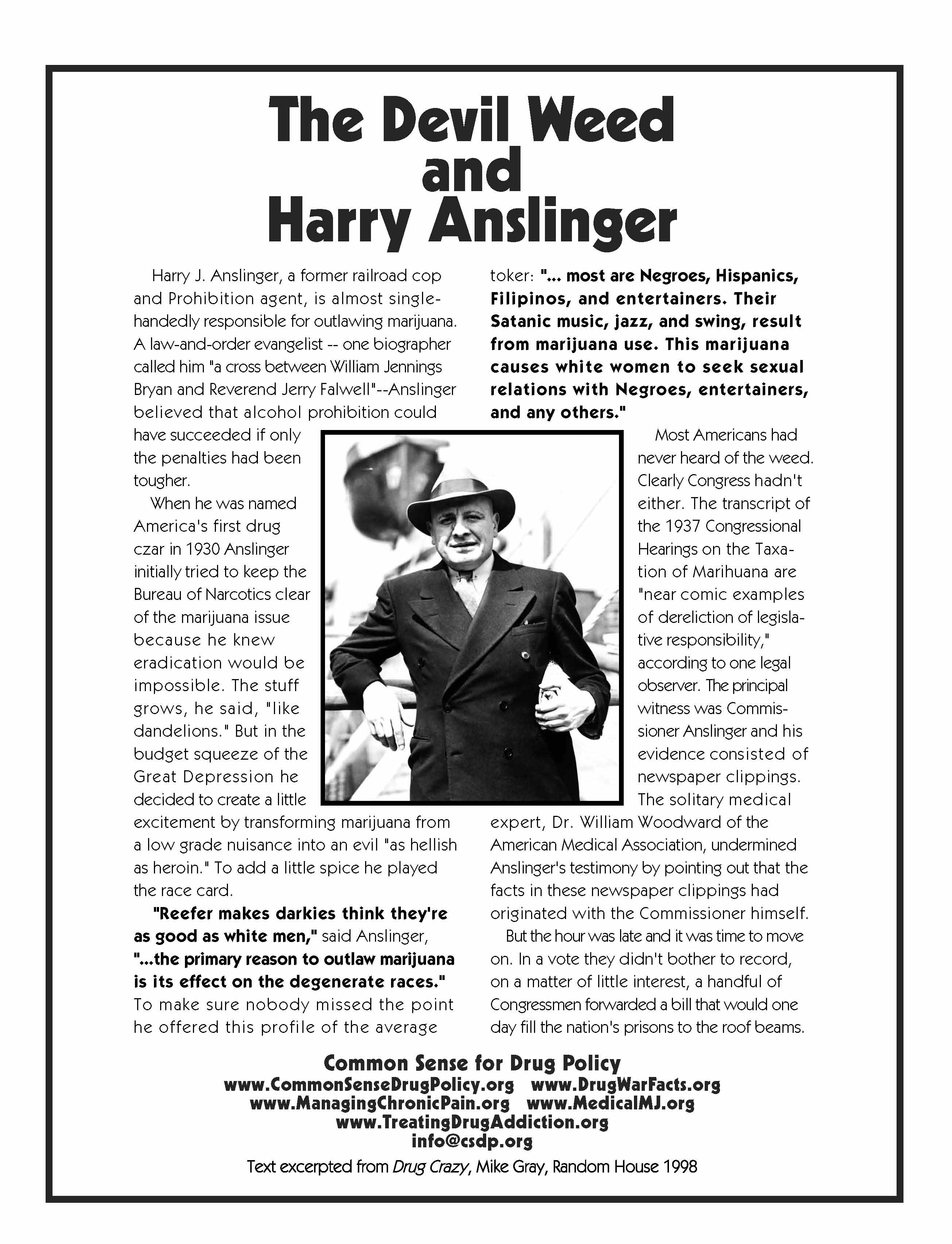
The Conservatives are blatantly playing "The Fear Card" which would surely make Harry J. Anslinger proud. In Canadian politics the fear-appeal is becoming increasingly rampant and widespread. I ask you to remember the following: whenever you hear any person in a position of legislative power and that person (or party) agitates the public's fear of crime and proposes that supporting a bill will reduce the perceived threat, he or she may be using this tactic as a means to induce fear and to imply that other people or parties are not concerned with crime and community safety.
“Since the Canadian government justifies this criminalization, in part, as a means of protecting our youth, we are standing up and saying, ‘not in our name.’” ~ Canadian Students for Sensible Drug Policy
MP Mark Holland: "The Harper government claims to be "tough on crime," but their discredited U.S.-style policies on crime and punishment are making Canadians less safe.
Their ineffective and costly plan, entitled A Roadmap to Public Safety, should more accurately be entitled A Roadmap to Public Disaster.
Modelled after failed American policies even diehard Republicans now admit are an abject failure, it will result in more prisons and longer sentences, while doing nothing to reduce recidivism. When over 90% of the prison population will be released, the Harper government's failure to seriously invest in vital programming needed for rehabilitation and reintegration, including substance abuse treatment and mental illness care, is nothing short of reckless." -
I'd also like to add that the Consevatives have not produced any evidence or research that proves these "Tough on Crime" measures are effective in keeping people safer or reducing crime. Our neighbours to the South have been down this failed road.... why would Stephen Harper want to follow down the same doomed path, and at great expense to Canadian Taxpayers? (Read "House passes billions of dollars in crime bills, doesn’t know full costs")
I'm no bleeding heart either, I'm a firm believer in harsh and long punishment for criminal perpatrators that truly deserve it - for convictions of murder, rape, vehicular manslaughter, domestic and child abuse, paedophelia, child abduction, etc. - crimes that truly harm the physical and emotional well being of our fellow human beings. But the Tories are not distinguishing the difference between violent criminal acts and non-violent offenses. They are lumping all acts together 'cause you know, that "CRIME!" word is super scary and it's a great vote getter too. They are depending and praying on your fear. Please don't be fooled.
"When you come to these kinds of issues, I think a good deal of humility is in order. These reforms have stood the test of time. It was for later generations of politicians to take a more incautious, exclusive, dogmatic stand to treat other opinions as if they were, if not illegitimate at least somehow "beyond the pale," and they polarized opinion. To the extent that opinion was polarized by those, if I may put it this way, on the left, it provoked an equal and opposite reaction from those on the right — wedge issues. Then we come to a situation in which one group of politicians is pointing a finger and saying, "They are soft on crime" with another group saying, "These fellows are hangers and floggers."
It is lunacy. If one hears people saying those things in Parliament, in Canadian politics, about each other, you know you are listening to lunatics. There is no other way of putting it. It is nuts." ~ Senator Murray
Honourable senators, this issue of Bill C-25 is a serious one. Surrounding this bill there has been a lot of — I will use a word that I do not like to use on the Senate floor — "politicking," which is essentially concentrating attention on political slogans instead of looking at the merits of the bill. My intention this afternoon, in reply to Senator Wallace, is to concentrate on the merits of the bill and avoid any politicking or political slogans.
The problems I have with this bill are threefold. The first one relates to the Charter. This bill has three serious Charter implications. I am not inventing them for honourable senators this afternoon; I draw those conclusions from the testimony of five experts that we heard. I will quote from them later in my intervention this afternoon.
Second, this bill will have a serious impact on the condition prevailing in the prisons for the inmate population and the staff that is there to maintain order and serve them.
Third, this bill will affect drastically the most vulnerable in the prison system, namely, people suffering from mental disorders, Aboriginal people and women. As an aside on the bill's impact, we heard from the president of the Canadian Association of Crown Counsel that it will clog the bail courts. That is not the impact that is wanted by those who drafted the bill. I totally recognize the objectivity of their intentions, but that impact is what we heard from the expert witnesses.
Let me return to my first point: This bill will have serious impact on the Charter and will be open to challenge in the courts.
As senators, it is one of our duties, when we are called upon to support the bill, to question its implications for the Charter. In the respected intervention of our esteemed colleague, Senator Wallace, neither yesterday nor today did he answer those issues that were raised by the witnesses, which the honourable senator well knows — as do Senator Nolin, Senator Angus and Senator Carignan, who sat during the long hours that we spent studying this bill.
Honourable senators, let me report what we heard from those experts. First, we heard from Michael Spratt of the Criminal Lawyers' Association that:
Bill C-25, if passed, will result in constitutional litigation. Bill C-25 offends the Charter. It will have the real effect of doing something that we do not seek to do in sentencing. In sentencing, we seek to treat like offenders who commit like offences in similar ways.
One can imagine a number of scenarios where like offenders who commit like offences and who have like personal circumstances are punished differently. One of those punishments is spending an inordinate amount of time in remand facilities with no programming and harsh conditions, much like the individuals who did not get their bail hearing today. They are not receiving programming. . . .
Pre-sentence detention is not lenient, it is cruel.
The impact of this bill is that it will treat people who are in remand differently than people who will be sentenced, having been freed once the charge is laid. That is one side effect of the bill as it is drafted.
Mark Lapowich, from the Canadian Council of Criminal Defence Lawyers, stated:
I do not think there will be any doubt . . . that there will be Charter challenges. In terms of specific challenges, we can envision challenges under section 7, deprivation of, life, liberty . . .; and a challenge under section 11(b), undue delay. We can see stay applications being brought; and, as was mentioned previously, for cruel and unusual, in terms of your specific point that you raised with respect to how horribly we have done in the past 50 years in relation to upholding treaties that we may be part of.
In other words, there will be Charter challenges on the basis that the sentence applied to one accused will be different from the one applied to another accused with exactly similar circumstances but in a totally different context. That situation offends the natural justice principle that people who are guilty of the same offence under the same circumstances should be given the same sentences and should bear the same consequences.
Let me quote, honourable senators, from another of those representatives from the objective groups that we normally hear from. The secretary of the national criminal justice section of the Canadian Bar Association, Eric Gottardi, said:
I think the prospects of constitutional challenges to the legislation are quite high. I think they could be many and varied. . . . I think the likelihood is quite high that that there will be constitutional challenges of different kinds.
That view is from the Canadian Bar Association.
We then heard testimony from the president of the Canadian Association of Elizabeth Fry Societies, Lucie Joncas, who said:
I am also concerned about whether such a practice would be considered constitutional. Given that, in 2000, the Supreme Court recognized that it was perfectly justified, and given that detention conditions at provincial level have deteriorated significantly, I do not see how the practice can be said to be no longer justified.
What are the court decisions that those experts refer to? They are essentially the unanimous court decisions of at least four appeal courts of provinces: the Court of Appeal of Quebec — from which I will quote immediately; the Court of Appeal of Alberta; the Court of Appeal of British Columbia; and the Supreme Court of Canada.
What does the Supreme Court of Canada rule on that principle of one for one — one day in pre-sentence custody versus one day once an offender is sentenced in regular prison?
I quote from the decision of R. v. Wust, a unanimous decision in 2000, at paragraph 45, which states:
In the past, many judges have given more or less two months credit for each month spent in pre-sentencing detention. . . . The often applied ratio of 2:1 reflects not only the harshness of the detention due to the absence of programs, which may be more severe in some cases than in others, but reflects also the fact that none of the remission mechanisms contained in the Corrections and Conditional Release Act apply to that period of detention. "Dead time" is "real" time.
In lay terms, what does that paragraph mean? It means that when someone is in remand custody, that person has no access to rehabilitation programs. The time that person is kept in pre-sentence custody cannot be counted as time toward conditional release — parole release. The person does not benefit from any of those programs that exist once an offender is in prison serving a sentence. The person experiences harsher conditions in pre-sentence custody than if that person is in jail once the sentence has been imposed by the judge. This is an important element and one that the Canadian Bar Association, under the signature of its chair, responded to on September 15, indicating that unjustified disparity in sentencing could result from the passage of Bill C-25.
The Canadian courts have upheld the principle that judges must take into account the different time and the quality of that time when prisoners are held under pre-sentence conditions as opposed to being held in jail. Let me quote the decision of the Court of Appeal of Quebec of 2005, a decision for which appeal was sought in the Supreme Court of Canada, which appeal was denied. In other words, that decision of the Court of Appeal is seen by the Supreme Court of Canada as being definitive. I quote from paragraph 40.
Thus, there are two primary reasons for this practice: the harsher conditions of interim detention and the impossibility of being granted parole during this time. That is why interim detention has become known as "dead time."
One of the most eloquent conclusions of that decision is found at paragraph 42.
Furthermore, the 2 to 1 ratio cannot be considered an advantage for the accused.
This is very important. Some people have the perception that the two-for-one or the one-for-one-and-a-half is a benefit, a premium. With that option comes the perception that it can be stretched, but this is not what the court has ruled. The British Columbia Court of Appeal ruled on a similar matter last year with regard to a decision in August 2008 on the case of R. v. Orr. I quote from paragraph 20 of the decision.
A lesser credit, generally in the ratio amount of one and a half-to-one seems more appropriate where the offender has been held for the pre-sentence period in an institution where post-sentence type programs are available. A refusal by a sentencing judge to allow any credits seems to me an erroneous approach having regard to the majority of existing authorities in Canadian appellate courts and the Supreme Court of Canada.
That is the most recent decision.
In other words, it has been established quite clearly that you have to maintain a balance between the time served in pre-sentence custody and the time served in prison. This bill equates the one-to-one challenges that form the fundamental principle of Canadian courts — the Supreme Court of Canada and all the provincial appellate courts — to rulings to maintain a relationship to the one-for-one principle.
It is easy for public opinion to support the one-for-one principle, but it violates one essential principle: Those in pre-sentence custody do not have the benefit of programs available for rehabilitation to reintroduce them into society. We want released prisoners on the streets to behave like good Canadian citizens.
Honourable senators, that is my first point. There are two other sections of the bill for which the constitutionality has been raised. One was raised by Senator Baker yesterday, the proposed section of the bill that allows the judge, in imposing that kind of sentence, to withhold the reasons. We all know that a sentence is appealable. It is a fundamental principle just as you can appeal the principle that you are found guilty. Those are the fundamental principles of our common-law criminal system. This bill takes away the obligation of judges to justify and explain the reasons for the sentence. That would go against that fundamental principle of our system, and there is no doubt that could be challenged in the court. I will not elaborate by quoting cases in the Supreme Court of Canada because the jurisprudence is clear.
There is another aspect of the bill that could be open to a court challenge, and that is a point Senator Nolin raised with one of the expert witnesses, namely, the arguments as to why a person should be detained in pre-sentence custody. The testimony we received from Mr. Munson on this is clear. If it was interpreted differently than what we were told it could be interpreted as, that could be open to challenge.
There are at least three aspects of this bill that raise important fundamental constitutional issues. That is my first point.
My second point, honourable senators, is that this bill will create more dangerous conditions in Canadian prisons, endangering the health and life of the inmate population as much as the personnel charged with the responsibility of operating the prisons. I am not inventing this situation. We had the benefit of hearing from the Canadian prison ombudsman, a person who is neutral and is there to look into the prison system, receive complaints, evaluate the context into which the prisons operate and make recommendations.
We heard from Mr. Howard Sapers, the Correctional Investigator of Canada, on September 30. Here is what Mr. Sapers testified during the study of this bill. He said:
. . . Bill C-25 will likely lead to a significant increase in the offender population managed by the Correctional Service of Canada.
I underline "a significant increase in the offender." He continues:
A significant increase in the federal inmate population will affect the safety and security of that population, as well as individual inmates' ability to receive programs and services that will assist their timely and safe reintegration into their home communities.
Listen to this aspect of his testimony.
. . . the current level of tension and violence within Canada's penitentiaries is already excessive. For example, for the first quarter of this fiscal year, the most recent data available, the correctional service reported a staggering total of 2231 security incidents and 577 reported physical injuries to inmates. During this three-month period, the security incidents included assaults on inmates, disciplinary issues, inmate fights, medical emergencies, self-inflicted injuries and three deaths.
That was in three months. Multiply that by four and you will have at least 12 deaths, at least 10,000 security incidents and at least 2,000 reported physical injuries to inmates. Why? Because this bill, when it is implemented, will bring, according to the statistics we received from Statistics Canada justice division, 10 to 12 per cent more inmates into the prison population.
Again, I refer you to the testimony of the ombudsman. "A significant increase in the federal inmate population will affect the safety and security of that population, as well as individual inmates' ability. . . ."
I questioned Mr. Don Head, the Commissioner of the Correctional Service. I have his testimony here. I tried to get from him the percentage of the so-called increase in the Correctional Service of Canada budget that will be devoted to dealing with that influx of 10 per cent more inmates and the consequences that it will have on the safety and the health of inmates and personnel. Here is what I got. Mr. Head answered:
In terms of disclosing the numbers, at this point I cannot disclose them because they are considered to be cabinet confidence.
In other words, honourable senators, we were told that this information was out of our reach in order to determine if this bill would have a severe impact on the health and life of the inmate population, with the proper balance of budgetary investment to maintain the current level of safety, which is critical according to the ombudsman who reported to us.
This is important because it deals with the kind of approach we should have regarding the inmate population. It would be easy, honourable senators, to mount public opinion against the inmate population. "Let us keep them in prison. Let us lock them somewhere and we do not want to hear about it." However, we need to try to understand who those people are. Are they all the Clifford Olsons of this world? Are they all criminals who are beyond the reach of rehabilitation or are there different kinds of citizens among them who are victims themselves, in a way, as a result of the circumstances of family, education, birth and so on?
I want to draw to honourable senators' attention that this bill will have a disproportionately severe effect on the vulnerable populations in the prisons. Who are they? It will be surprising for you, honourable senators, to understand that it will be the offenders suffering from mental disorders.
The population of our prisons is composed mainly of Aboriginal people. About 20 per cent of Canadian inmates are of Aboriginal origin. They form 3 per cent of the Canadian population and yet they form 20 per cent of the inmate population. In Saskatchewan, it is as high as 80 per cent and above 50 per in Manitoba.
In other words, we are dealing with offenders with significant social backgrounds. One cannot just say, "We will lock them up and forget the key and, when they get out, everything will be fine."
Again, I quote from Mr. Sapers, the ombudsman, who reported that:
This is of importance to the study of Bill C-25 because offenders with mental illnesses and cognitive difficulties are often held in pre-trial custody. We know that the prevalence of offenders with significant mental health issues upon admission has doubled in the past five years.
In fact, another witness stated that the ". . . Aboriginal adults admitted to remand custody increased by 23 per cent compared to a 14 per cent increase in the total remand admission rate over that same period."
In other words, we are putting more Aboriginal population in prison and remand. This is a serious problem, honourable senators, if we add that to the people suffering with mental disorders. The problem with people who are affected by mental disorders is that, as Mr. Sapers stated, "Federal prisons are now housing the largest psychiatric population in the country. . . ." It has doubled in the past five years. If one was to ask where are the majority of the Canadians who suffer from psychiatric problems, the answer would be that they are in prisons. They are not in psychiatric institutions or under the kind of care that one would like to have if someone in their family suffered from a psychiatric disorder.
Mr. Sapers also stated:
. . . despite the need, the capacity of the federal correctional system to respond to and treat mental illness is largely reserved for the most acute or seriously chronic cases — those receiving psychiatric treatment in one of the five regional treatment centres. Most other mental health problems receive limited clinical attention, at best.
This means that, when those people have served their time, they are released onto the street with no real capacity to reintegrate into a normal course of life. It is so much so that the accessibility to rehabilitation has been severely cut by the lack of funds.
Let me quote from Mr. Zinger, the Executive Director and General Counsel of the Office of the Correctional Investigator. He testified at the committee:
The Correctional Service allocates only two per cent, under $41 million of a $2.1 billion total annual budget, to offender programming.
For now, offenders have to contend with long waiting lists for programs and with cancelled programs because of insufficient funding or lack of trained facilitators.
They also have to deal with delayed conditional release because of the service's inability to provide the timely programs they require.
They must therefore serve longer time before parole consideration.
In other words, there is not enough capacity to offer the programs that would help those inmates to reintegrate into normal life.
Honourable senators, you will understand those aspects of Bill C-25, outside the hoopla of the political game of name-calling and trying to address emotion rather than the substance of this bill, is very serious.
I will conclude by referring to another witness whom we hear from very rarely at the Standing Senate Committee on Legal and Constitutional Affairs. I have been serving on that committee for 12 years now and we have never heard a representative of the Crown counsel. Why? Of course, the Crown counsel is the Department of Justice, either provincial or federal. It is the government. This time, we heard from the President of the Canadian Association of Crown Counsel, Mr. Jamie Chaffe. It was extraordinary to have him testify. He said that, from his association's perspective, it was certain that there would be an increase in the workload in the bail system. That could only be reasonably expected since part of the sentencing process would be imported into the bail hearing itself, which would likely be fully litigated by defence counsel and the Crown. In other words, by trying to alleviate the condition in the remand centre, we will be clogging the bail court.
Mr. Chaffe was questioned by all of us around the table because it was such an important element to consider before supporting this bill. We thought this information had to be shared with all senators in this chamber before voting on this bill.
I do not doubt that the intention of the government to try to frame the discretion of the judges is a legitimate objective.
However, when it is framed in a way that there are unintended consequences in the system, either in the courts by clogging the bail courts or in the prisons by creating more dangerous conditions, and by putting the weight on those who are the most vulnerable, the result might not be the one contemplated at the beginning. There has to be the proper commitment of budget and human resources, and the proper capacity of monitoring such that this initiative will be sound, humane and will serve the objective, which, as Senator Wallace has said, is to increase safety and security in Canada.
Honourable senators, that might be a different tone than what you have heard in the hoopla surrounding the debate on this bill. However, those are the serious considerations that I thought were useful to bring to your consideration before you vote on this bill later today or this week.
Hon. Jerahmiel S. Grafstein: Honourable senators, if Senator Watt is to enter the debate, I want to ask some questions.
Thank you, Senator Joyal for that presentation. This topic is not new to this chamber or the committee.
In 1994, the Minister of Justice Allan Rock — I see a senator on the other side nodding in agreement — who came from Toronto, raised the issue for the first time because of the overcrowding of the court system in terms of bail, remands and prisons. The rationale for that decision taken by the Minister of Justice was that the court system and jails in Toronto were overcrowded. It was going from bad to worse. There was agreement on both sides at the time that this bill needed remediation.
Having said that, it is my understanding that the court system in Ontario — the province I represent — is worse today than it was then. I look at other members from Ontario. They should take a look at this question before they opine on this bill. I think they will come to the same conclusion. The court system in Ontario is worse today in terms of clogging the courts, reasonable remands and bail. Prisons are also more crowded today than they were 14 years ago.
Did this evidence come forward to the committee as to whether there were budgets available at the provincial, municipal and federal levels to expand space availability in prisons that will be required if this bill goes into effect?
Senator Joyal: Honourable senators, I will quote Ken Crawford, corrections staff representative from the Winnipeg Free Press on the sixth of this month:
All provincial jails within this province are presently overcrowded. . . . Our institutions are at the breaking point.
The honourable senator was talking of Ontario; this article is from Manitoba. The newspaper was reporting about a mutiny in the correctional centre in Brandon. The article continued:
They'd like to see trailers to house at least 200 people in order to ease overcrowding. The trailers can house 20 to 60 people, said the union
The article goes on to quote Peter Olfert, Manitoba Government and General Employees Union president:
(The province) are looking as moving as quickly as they can to provide portable units.
In other words, this problem is not peculiar to Ontario. It is the same in Manitoba, according to what I read. I would say it is the same in Quebec.
If I remember correctly, in June, a front page article in La Presse described conditions in the provincial prisons. Although some provinces might have announced budgetary initiatives, construction will not keep up with the increase of population we will experience by adopting minimum sentences, or by the fact that remand population will increase. This increase is not because people want to stay in prisons, but because cases are more complex. That is the witness testimony we heard. Cases are more complex, hearings are longer and personnel in the courts are not always available. A clogging of the court system exists generally, and it needs a massive injection of funds.
We have to take into account that element of reality with all the bills we are requested to vote on. We continue to add to a system that is already cracking all over the place. At a point in time, we must understand that what we do may have an unintended adverse effect because we are creating additional pressure in the whole system.
Senator Grafstein: Honourable senators, I have another question relating to Toronto and my province of Ontario. It is my understanding that the urban Aboriginal population in Toronto is the largest in Canada in absolute numbers. While there is a problem in Regina, Winnipeg and other places in the West, the largest problem in quantitative terms is in Toronto.
Senators from Toronto will know the statistics well when we talk about the homeless. At least two thirds of the homeless on the streets in Toronto are Aboriginal. Of the Aboriginal community on the streets, about two thirds of them — maybe more — are on the streets because of psychiatric or emotional problems. This information is confirmed in a report.
Again, we have a more intense problem in Toronto. I assume the committee sorted this problem out as well. When we come to the question of bail, remand or incarceration, Toronto now has probably the largest proportion of Aboriginals convicted in Canada without any remediation.
Did this issue arise in the committee study? Have you any comments about that issue?
Senator Joyal: We did not hear any witnesses from the Aboriginal community. I want to put that information on the record. We did not hear representatives of the Assembly of First Nations, other national groups that represent Aboriginal people or provincial groups like the Cree or Innu of Quebec.
The issue came to us as a side issue. As I mentioned earlier, we will create additional pressure on the system. Our colleague, Senator Watt, who intends to speak this afternoon on this issue, is a member of the committee. He has raised this issue regularly with the witnesses. At a point in time, that problem must be addressed. It cannot be ignored. It is the major problem of the Canadian inmate population.
At this stage, we could not study more than the purpose of this bill and the reference we received from the Senate, which was to study the scope of the legislation.
Senator Grafstein: Finally, we have been confronted in the past — I look at new senators in regard to this problem — with a situation in the criminal justice system and other places where a bill is not in sync with the economic reality. I suspect and assume this bill is not.
Did the committee — all members of the committee — give any consideration to suggesting an amendment that will allow the bill not to come into effect if it is passed until such time as Her Majesty the Queen and cabinet can be satisfied that there are adequate facilities both at the court level and in the prison system to accommodate the increase in prisoners incarcerated?
Senator Joyal: The answer is no, honourable senators.
I mentioned earlier, Don Head, Commissioner of the Correctional Service of Canada appeared as a witness. He is the "big boss" of the prison system in Canada. We tried to obtain the figures and statistics on how much of the budget will go for bricks and mortar and how much will go to rehabilitation programs, training, personnel, et cetera. We could not obtain proper detail on those figures. Mr. Head told us those figures were deemed confidential documents. To answer your question, yes, the figures exist somewhere, but they were not made available to us.
While this post doesn't discuss prohibition specifically, I feel it is a very important topic for Canadians to be aware of so I've decided to include it here on my blog as it speaks to the benefits of rehabilitation programs as opposed to the Conservative punish happy ideology.
"The decision to shut down this successful rehabilitation program symbolizes our government's lack of understanding of what actually makes the public safe, and their failure to recognize the value of a restorative approach to justice and a sustainable, local approach to the future of farming and food." ~ Save Our Prison Farms National Campaign
Photo from NUPGE article Major campaign launched to save prison farms - "Dating back to the 1880s, the program includes two operations in the Kingston, Ont. area, and others near Dorchester, N.B., Stony Mountain, Man., Prince Albert, Sask. and Innisfail, Alta."
~SAVE OUR FARMS! - The ‘Save Our Farms’ campaign was launched by the men and women who oversee, instruct and work with inmates in federal prison farm programs, members of the Union of Solicitor General Employees (USGE-PSAC). They welcome the support of national, regional and local organizations that have an interest in a safe, secure and sustainable food supply. Also read "THE FUTURE OF PRISON FARMS II" and III which also includes great audio interviews. Please be sure to take notice of all the awesome links in the sidebar as well.
According to one retired Corrections employee, it would seem that the farm program has a proven track record for its rehabilitative impact. Of the 50-plus inmates that were released during his employment at Frontenac Institution, not one reoffended. Perhaps there is something to be said for a program that promotes accountability through work that heals and helps one along the path to become a better human being.
The Conservatives don't blink an eye at spending at least 1.1 BILLION dollars of taxpayer money on the G8/G20 Summits - but $4.1 million for a program that helps inmates develop valuable life skills that they can use upon release into the community while at the same time providing food for correctional centers gets wiped out - "When they start buying that food (after the program ends) it will cost them at least 50 per cent more on top of what they’re spending." (Tony Abreau, relief instructor for Corcan). And a dairy farmer asked if they planned to import that produce from the US. No officials could answer that question.
"The Conservative government said that it will sell off the prize dairy herd at Frontenac Institution this June, effectively putting an end to the 50-year-old facility. The Frontenac farm supplies milk and eggs to federal prisons in Ontario and Quebec. " - Sludge issue could be costly for prison farm closure, memo indicates
Keep prison farms open, Liberals urge By Rick McGee SooToday.com Tuesday, May 11, 2010
NEWS RELEASE
OTTAWA – Liberal Leader Michael Ignatieff is warning against the Harper government’s decision to cut Canada’s federal prison farms, and is calling for an immediate independent review of the program before prison farms are permanently closed.
“Prison farms benefit everyone involved in them: farmers, corrections workers, and inmates,” Mr. Ignatieff said. “Because Liberals recognize the necessity of rehabilitation programming for preventing repeat offenses, we are demanding an immediate review, in the hopes of preventing the Conservatives from closing these farms.”
Last year, the Harper government announced their plan to phase out six prison farms that currently employ 300 federal prisoners. Last month, the House of Commons Public Safety Committee asked the government to release the strategic review of prison farms from the Department of Correctional Services.
Liberals are calling on the government to wait for the independent review to be completed before moving forward with the closure of any prison farms. The Conservative decision to close prison farms would likely be irreversible, as land and equipment will be sold for other uses.
“The Harper government only cares about locking more people up and throwing away the key in their planned super prisons,” said Liberal Public Safety Critic Mark Holland. “They’ve ignored the fact that inmates working on prison farms develop critical life and employability skills that reduce their risk of re-offending after release – helping to prevent crime and protect our communities.”
There are six prison farms in Canada -- two within the city limits of Kingston, and one each in New Brunswick, Manitoba, Saskatchewan and Alberta. The prison farm program is considered an extremely effective rehabilitation and training program that contributes to public safety and that also provides food for federal and provincial inmates.
Mr. Ignatieff is calling for the Harper government to wait for an open and transparent independent review of the prison farm programs operated by the Correctional Service of Canada that will consider:
• The value of farm employment and training of inmates;
• The impact of the closure on rehabilitation programs;
• The influence that employment in the farm environment has on recidivism;
• The impact that farm closures have had on local agriculture economies; and
• The increase in the cost of operating prisons which are no longer able to purchase food products from prison farms.
“Local farmers appreciate the benefits of these productive prison farms for stimulating the local economy,” said Liberal Agriculture Critic Wayne Easter. “Unlike the Conservatives, our party recognizes the importance of these farms to helping offenders get back on the right track, and for supporting the communities where prisons are located.” - Fin
While I can report on the views of politicians regarding the closures, here's a great citizen "Letter to the Editor" from the Kingston Whig Standard worth a reprint:
Recently, I attended a public meeting in Kingston that addressed the current issue of prison farm closures.
Of particular interest was the impending closures of farms at Pittsburgh and Frontenac institutions.
This forum was an opportunity to hear MPs Wayne Easter, Liberal agriculture critic, and Mark Holland, Liberal critic for public safety, reflect on their recent tour of four of Canada's prison farm facilities.
Both were impressed with these operations; especially the two in Kingston. When they had an opportunity to speak with some inmates who worked on these farms, they noted their strong work ethic and sense of pride.
They also noted the broad skill set they were acquiring through such work.
According to one retired Corrections employee, it would seem that the farm program has a proven track record for its rehabilitative impact. Of the 50-plus inmates that were released during his employment at Frontenac Institution, not one reoffended. Perhaps there is something to be said for a program that promotes accountability through work that heals and helps one along the path to become a better human being.
Working the land, being responsible for the livelihood of animals, and broadening one's skill set, is a meaningful way to reach this end. The rehabilitation of inmates is crucial, as most will at some point be released into society. What kind of neighbour would you like?
The government has claimed that $4 million is lost annually by keeping these facilities open. What evidence is there of this? Perhaps we could speculate how much more might be lost if they were to tender food -- currently produced by the prisons -- to other providers (perhaps not even Canadian). Not only do these farms feed all of the inmates from these prisons and others, but they also donate a few hundred dozen eggs annually to the food bank. Uniquely, Pittsburgh Institution boasts an abbatoir as well; whose services are relied on by approximately 150 businesses in the Kingston area.
If a super prison -- which would house inmates from all levels of incarceration -- were to be built in place of these prison farms, the rehabilitative benefit of inmates would be significantly reduced. This style of institution has been tried in the U.S. and was unsuccessful. They now recognize the wrong-headedness of this direction. Why then would we want to follow in failed footsteps?
Finally, how can we, in clear conscience, sacrifice land, classed as prime agricultural, when fertile ground is being eaten up by development on a daily basis? Can we really afford to keep relying on other countries to feed us? This seems unconscienable, given the issue of food security and the ongoing oil crisis. Does this really make financial sense? Are we that removed from our roots? ~ By Sue Peters Inverary
From the Save Our Prison Farms National Campaign (*PLEASE* visit the site):
This new Save Our Prison Farms website has been set up by the national campaign team to respond to growing public concern over the immanent shut down of Canada's six prison farms. We believe that our government will reverse its misguided policy decision as it continues to discover that the vast majority of Canadians of all political stripes support this productive, cost effective, rehabilitative farm-based program.
Opportunities for you and/or your organization to get involved are listed on the You Can Take Action page.
This campaign is a lightening rod for addressing the Conservative Party's generally short-sighted policies on farming, food and justice. The decision to shut down this successful rehabilitation program symbolizes our government's lack of understanding of what actually makes the public safe, and their failure to recognize the value of a restorative approach to justice and a sustainable, local approach to the future of farming and food.
Save Our Prison Farms Information and Action Meeting
Thursday, May 27th, 7:30pm - Perth, Ontario
Perth Lions Hall, Perth Fair Grounds
Speaker include: Mark Holland, Liberal Public Safety Critic; Mike Schreiner, Leader of the Green Party of Ontario; Dianne Dowling, National Farmers Union, Local 316 President; John Williamson, Frontenac Federation of Agriculture, Past-president.
"Last October, the Harper government appointed Bernard Prigent to the governing council of the Canadian Institutes of Health Research, the federal agency that distributes about a billion dollars annually for health research. That appointment was met with near-universal condemnation from medical ethicists, because..."
The video is a little over half an hour, but well worth the time! I think all politicians should listen to it, so they know that we are here raising our voice and we will never, ever stop fighting to end prohibition!
Ethan Nadelmann, Executive Director of the Drug Policy Alliance at the 2009 Drug Reform Conference in Albuquerque, New Mexico: "Right now the wind is at our back" from Hungarian Civil Liberties Union. Thank you to the HCLU for filming, please visit their link for more pictures and info about the conference.
UPDATE: And even more awesomeness from Ethan Nadelmann, I really just can't say enough about how much I respect and admire all of the work Mr. Nadelmann puts forth towards reforming our drug laws and ending prohibition.
"The U.S. House Domestic Policy Subcommittee, chaired by Rep. Dennis Kucinich (D-OH), held a hearing Wednesday April 14th. on the White House's drug war budget and forthcoming 2010 National Drug Control Strategy...." Read Mr. Nadelmann's testimony, as always, he's brilliant.
"When questioned by New Democratic MP Libby Davies at the committee, Nicholson refused to provide two vital pieces of information: What evidence is there that this law will reduce crime? How much will it cost?
Canadians ought to be given these answers. Instead, Nicholson told the committee: "We are absolutely convinced in our consultation with Canadians that this is welcomed." In other words, the government did a poll on the bill. As Davies rightly noted, "this bill is not about crime; it is about politics."
Of course, in a minority Parliament, the opposition parties could kill this initiative. But while the New Democrats and the Bloc Québécois have voiced strong opposition to Bill C-15, the Liberals have indicated they will support it when it comes back to the Commons for third reading.
Why? Not because they think it is sound policy; they acknowledge in private that it is not. Rather, the Liberals do not want to give the Conservatives an opening to accuse them of being "soft" on crime. This is craven politics at its worst." - From "'Tough' drug bill all about politics"
“Since the Canadian government justifies this criminalization, in part, as a means of protecting our youth, we are standing up and saying, ‘not in our name.’” ~ Canadian Students for Sensible Drug Policy
"Retired Quebec judge John Gomery says the Harper government’s plan to create mandatory minimum jail terms for drug crimes is a “slap in the face” to judges and suggests the Conservatives don’t trust them to craft appropriate sentences for individual cases." ~ "Judges resent ‘implied criticism’ of mandatory minimum sentences: Gomery"
"About 73% of federal dollars on drug policy in Canada go toward enforcement. Only 2.6% goes to prevention, only 2.6% goes to harm reduction and about 14% to treatment. That is a very uneven balance." ~ MP Libby Davies
The Conservative government is slandering Liberal Senators in the House of Commons regarding Bill C-15. In reality, the Senate Committee is giving the extremely flawed bill a thorough investigation. Isn't that their duty? Don't Canadians deserve sober second thought about what will become the laws of our land? Do the Tories not appreciate that you can't hastily blaze through democratic process?
"Senators are entrusted to uphold the foundation of our democratic system, based on a respect for minority rights. The Senate provides a voice for those who are overlooked, those who struggle to be heard, and those who are inclined to remain silent. This is a privilege we take seriously and we strive to accomplish great things in our role as Liberal senators." ~ Liberal Senate
On the Canadian Department of Justice website their mandate states:
The Mission of the Department of Justice is to:
support the Minister of Justice in working to ensure that Canada is a just and law-abiding society with an accessible, efficient and fair system of justice;
provide high-quality legal services and counsel to the government and to client departments and agencies; and
promote respect for rights and freedoms, the law and the Constitution.
Integrity and fairness
As public servants supporting the Minister of Justice and Attorney General, we are committed to respecting and obeying the law and upholding the highest standards of integrity and fairness.
"Respect for rights and freedoms, the law and the Constitution..... upholding the highest standards of integrity and fairness...." The Conservatives seem to be ignoring the Department of Justice Mandate, because they have certainly ignored the rights of Canadians (fair and proportionate sentencing), is attempting to further steal freedom and personal autonomy (security of the person, which consists of rights to privacy of the body and its healthand of the right protecting the "psychological integrity" of an individual. That is, the right protects against significant government-inflicted harm to the mental state of the individual. (Blencoe v. B.C. (Human Rights Commission), 2000) and have definitely not shown an ounce of integrity or fairness as they continue to provide no evidence to support the intended purpose of Bill C-15 - which is to reduce crime, recidivism, drug dependence, and make Canadian communities safer.
The Conservatives are blatantly playing "The Fear Card" which would surely make Harry J. Anslinger proud. In Canadian politics the fear-appeal is becoming increasingly rampant and widespread. I ask you to remember the following: whenever you hear any person in a position of legislative power and that person (or party) agitates the public's fear of crime and proposes that supporting a bill will reduce the perceived threat, he or she may be using this tactic as a means to induce fear and to imply that other people or parties are not concerned with crime and community safety. When confronted with persuasive messages that capitalize on our fear, we should ask ourselves the following questions:
* How legitimate is the fear that the speaker is provoking? * Do they present facts and evidence to support their claims? * Will performing the recommended action actually reduce the supposed threat? * Is the speaker exaggerating the fear or threat in order to obtain my support? ("profit from propaganda")
In the Tory version of events, they profess the Liberal Senators are stalling and "gutting" the bill . But let's take a closer look at the facts, shall we? I know it is a lot of information, but if politicians are going to table bills I believe that they must be honest with Canadians and supply truthful evidence. If they don't they should be prepared to be "Called Out" (v. To announce to someone that one knows the others lies, deceit, intentions or misinformation.) on their lack of proof and give more than a "Because some Canadians told us" defense.
Previous to reaching the Senate, of the 16 experts called to testify on Bill C-15 at the Standing Committee of Justice and Human Rights, 13 called for the outright dismissal of the bill. Critics of the bill say evidence overwhelmingly shows mandatory minimums simply don't work, can be extremely expensive to enforce, and cause more harm than good.
MPs approved the bill without any empirical evidence that harsh sentencing laws reduce drug crime. They endorsed the policy without any estimate of how much it will cost to jail thousands of marijuana growers and street pushers.... They changed the law without any plan to contain the spread of AIDS, hepatitis C and other drug-related diseases in the prison system.
Justice Minister Rob Nicholson admitted as much last month when he appeared before the Commons justice committee. Challenged to provide proof from any country in the world that mandatory jail time deters drug use or improves public safety, he responded: "I can tell you, there is support for this bill from many ordinary Canadians who are quite concerned about drug abuse."
He was asked for concrete information and he provided none: no research documenting the benefits of harsh drug sentencing laws, no jurisdiction where they'd cut crime. (I'd like to add that contrary to the fact that the Conservatives are trying to scare Canadians that something urgently needs to be done to deal with soaring rates of both violent and property crime, our streets are safer today than 20 years ago. Violent crime has been generally dropping for years, and was lower in 2007 than at any time in two decades. The same goes for property crimes -- the recent rate is more than 40% below a peak in 1991.)
"The bill is based on a deterrence theory of punishment for which there is no evidence. In their article called “Sentence Severity and Crime: Accepting the Null Hypothesis”, Anthony N. Doob and Cheryl Webster concluded that 25 years worth of research, sometimes in ideal conditions, had shown that there was no support for the idea that harsher sentences reduce crime. They also point out that:
Deterrence-based sentencing makes false promises to the community. As long as the public believes that crime can be deterred by legislatures or judges through harsh sentences, there is no need to consider other approaches to crime reduction.
In other words, adding a harsher sentence is pretending to do something instead of actually doing something. The bill makes a false promise, to use their words. This approach is not smart on crime.
While mandatory minimums do not work, we do know what does work, and that is the four pillars: prevention, treatment, harm reduction and enforcement. Each pillar is equally important and they must be integrated and jointly implemented to be effective.
Sadly, we are not following the four pillars approach in Canada. In fact, we are doing the opposite. Listen to these numbers. Canada spends 73% of its drug policy budget on enforcement, 14% on treatment, 2.6% on prevention and 2.6% on harm reduction. These pillars clearly are not integrated and jointly implemented. They are clearly not even being valued equally by the government. We have a government that is solely focused on enforcement, which is only one piece of the solution. As a result, drug use continues to rise.
In 1994, 28% of Canadians reported to have used illicit drugs, but by 2004, this number was 45%, almost double....This is what happens when a government is not smart on crime." (Read the whole speech here)
“Rob Nicholson has ignored the preponderance of scientific evidence and international experience, and now he is ignoring the Constitution”, said Kirk Tousaw, Executive Director of the Beyond Prohibition Foundation. “C-15 has profound implications for our criminal justice system and provincial budgets, the Senate has a constitutional obligation to study the implications of this bill, especially considering that the Conservatives did not.”
From "Stupid Is As Stupid Does": "the government plans to increase the size, and budget for federal penitentiaries in order to accommodate the influx of prisoners resulting from the new crime bills. The annual budget for prisons has grown from $88.5-million in 2006-07 to $195.1-million this year. And is projected to reach $211.6-million in 2010-11.
*****
"There's no way to rule innocent men. The only power government has is the power to crack down on criminals. When there aren't enough criminals, one makes them. One declares so many things to be a crime that it becomes impossible for men to live without breaking laws." - Ayn Rand
*****
So the Conservatives are intent to supply more "criminals" to fill all the new prisons they plan to build, and the only "evidence", which they failed to produce after repeated requests, is Canadians (all of us?) supposedly asked for Bill C-15. That's it. Gee, reminds me of when Cannabis was first made illegal in Canada: "Early drug legislation was largely based on a moral panic, racist sentiment and a notorious absence of debate" ~ The 2002 Senate Special Committee on Illegal Drugs
Saying no to Bill C-15 today in the House of Commons
Excerpts from Libby Davies speech in the House
HANSARD Blues House of Commons March 27, 2009
Ms. Libby Davies (Vancouver East, NDP): Mr. Speaker, I am very pleased to be up first on this Friday morning to speak to Bill C-15, which is mandatory minimum sentencing for drug crimes and amends the Controlled Drugs and Substances Act.
I represent the riding of Vancouver East and, as many people know, it is a riding that has been hit very hard with the seriousness of drug issues. For a number of years when I was first elected that the number of overdoses in the downtown east side was the leading cause of death. It was horribly alarming. It was the number one public health issue where people were dying needlessly, though these are preventable deaths, from drug overdoses because of prohibition and because of the illegal drug market, the black market, where people were buying things on the street and they do not know what they were. The level of overdoses was just horrific, and the chaos, the pain and the suffering that was caused in the downtown east side.
That still goes on today to some extent, but over the last 10 years, because of enormous efforts by the community and indeed right across Canada, particularly by drug users themselves who began to speak out about their own experience, the situation began to change.
It is very easy in our society to vilify and demonize drug users. It is very easy to label people as “criminals” and to label a drug user as a trafficker. In fact, under the law, even passing a joint to someone would be characterized as trafficking.
Not only are we trying to overcome the severe health and safety impact in terms of drug use in the downtown east side, but we’re also trying to deal with the terrible stigma and stereotyping that surrounds drug users.
The fact is that drug use exists at all levels of society. There are lawyers, professionals, engineers and all kinds of people who use drugs, whether medical or non-medical. If it is a prescription, that might be a substance use problem as well, whether a person gets it from a doctor or gets it on the street. It may be that a person is using drugs for recreational purposes, maybe marijuana.
It exists at all levels of society, but it is very much a class issue, because the enforcement regime that we have in this country, similar to the United States, is very much leveled at visible drug use on the street, basically people who are poor, people who are facing that stigma and often people facing challenges of mental health.
It is very much an issue that pertains to the poorest in our society who are involved in drug use and the enforcement, primarily in this country, as in the United States, has been leveled at those people.
About 73% of federal dollars on drug policy in Canada go toward enforcement. Only 2.6% goes to prevention, only 2.6% goes to harm reduction and about 14% to treatment. That is a very uneven balance.
For example, when the Auditor General audited drug policy in this country a few years ago, she remarked upon this and posed a question: What was the impact? What was the value? What were we getting for such a high emphasis on an enforcement and interdiction regime when drug use is actually going up in Canada?
It might interest people to know that in 1994, 28% of Canadians reported having used illicit drugs, but by 2004 that number was at 45%. Certainly, the policies we have had that have been so focused on the criminal regime and the criminalization of drug users have been completely ineffective. We only have to look south of the border, where the so-called war on drugs has unleashed billions and billions of dollars and where we see massive numbers of people incarcerated, to see what a failure it is.
Canada did have what was called the four-pillar approach, which was enforcement, harm reduction, prevention and treatment. That was adopted under a previous government. There was always an imbalance and an overemphasis on enforcement, but at least that four-pillar approach was there. I have to say that it actually began in Vancouver as a grassroots, bottom-up approach and then spread across the country.
This bill would take a radical departure from that four-pillar approach by emphasizing the enforcement regime even more, taking it to some greater lengths by bringing in a regime of mandatory minimum sentencing. I think this is a huge mistake. There is no question that it is the core of the Conservative government's agenda around crime. It is about the political optics. I have called it the politics of fear. People are concerned about drug use and crime in their communities. They are particularly concerned about young people being involved in using drugs. However, this bill will not deal with that. This bill will not change that situation. In fact, the evidence from both Canada and the United States shows us that the opposite will happen. It will only make the situation worse.
I want to note in the record that a Department of Justice study in 2002 concluded that mandatory minimum sentences are the least effective in relation to drug offenses. The report said:
Mandatory minimum sentences do not appear to influence drug consumption or drug-related crime in any measurable way. A variety of research methods concludes that treatment-based approaches are more cost effective than lengthy prison terms. MMS are blunt instruments that fail to distinguish between low and high-level, as well as hardcore versus transient drug dealers.
In fact what it will do is completely create chaos in our judicial system, in the court system. We know that for any mandatory minimums that are two years or less when people end up in the provincial court system, we are now going to be facing a huge overload in the provincial court system. Do the provinces know that? I kind of wonder if they realize what is coming down the pipe here.
We will also see situations where people are more likely to plead not guilty because they know that they will be facing a mandatory minimum.
This idea that we are going up to the kingpins just does not play out, because those are the individuals who are in the best position to negotiate with prosecution officials and so on. Again history has shown us that with enforcement, the easy pickings are basically people who are low-level dealers. They are often users themselves. This bill will be so punitive in terms of individual people, but the worst thing is it will not change the outcome.
In speaking to the bill, I feel this is a critical point: are we going to go down this path where we say that tougher laws and enforcement are going to solve drug issues in local communities?
The Conservative members have clearly said that. I am very interested to see what the Liberal caucus does with this bill. I hope that we can defeat it. I hope we can say it is not the right way to go. The NDP does not think the bill should go through. It is not based on good public policy. It is going to be harmful and expensive. It is really time to embark on a common sense approach and accept the overwhelming evidence that the war on drugs has caused more death, pain, harm and crime than we can bear. It is time to stop it.
I do not think that is going to happen overnight. However, let us at least have the courage to see what has failed and see the alternatives. We could begin with marijuana, real education, and look to decriminalization or even legalization, or we could continue on the tragic course of playing on people's fear and trying to convince people that tougher laws will make it all go away. It will not. Let us say no to the bill.
The judiciary in Canada and elsewhere are opposed to mandatory sentences of imprisonment. The Canadian Sentencing Commission (1987) found in their survey of judges that slightly over half felt that minimum sentences impinged on their ability to impose a just sentence and that inappropriate agreement between defense and Crown counsel may result.
The future of mandatory minimum sentences in Canada remains unclear. There is some indication that minimum sentences are not an effective sentencing tool: that is, they constrain judicial discretion without offering any increased crime prevention benefits. Nevertheless, mandatory sentences remain popular with some Canadian politicians.
Where mandatory sentences do exist, they have been the object of considerable (and growing) opposition from a variety of parties, including advocacy groups, judges, academics and criminal justice professionals. This opposition has led to a number of Bills to amend or repeal the mandatory sentences legislation. While a number of countries have passed mandatory sentencing legislation within the last decade, there is evidence that jurisdictions with the most severe mandatory sentencing laws are beginning to repeal, or consider repealing, the most punitive sentences of imprisonment.
Trends in Mandatory Sentencing Legislation - After a decade in which a number of common law countries enacted mandatory sentencing legislation, there is clear evidence that several jurisdictions are now either repealing or amending these punitive laws. For example, in 2002 the Michigan mandatory sentencing laws were significantly amended. The effects of these amendments include the following:
• elimination of mandatory minimum sentencing for certain controlled substance violations; • creation of provisions that permit courts to consider important mitigating factors; and • revision of the quantities of drug that trigger certain sentences.
This movement towards a more flexible, judge-determined sentencing scheme is a result of several factors with international repercussions including:
• a shift in public opinion away from supporting strict mandatory minimum sentencing (see above); • the impact of Advocacy groups such as Families Against Mandatory Minimums Foundation (FAMM); • growing public disenchantment with the “War on Drugs” that initially triggered many of the most punitive mandatory sentencing laws (see Eagleton Institute of Politics Center for Public Interest Polling, 2004); • news media coverage of “three-strikes” cases in which offenders whose “third strike” consisted of a less serious felony and stories of offenders receiving lengthy prison terms for offenses such as stealing a bicycle from a garage have undermined public support for this kind of sentencing; and • growing concern among criminal justice professionals that mandatory sentences have played an important role in keeping prison populations from declining, even in an era of falling crime rates.
Mandatory Sentencing and Public Opinion - Although this report deals only with the statutory regimes with respect to mandatory sentences of imprisonment, it is worth noting that there is evidence from a number of jurisdictions that public support for mandatory sentencing has declined over the past decade. Mandatory sentences of imprisonment represent the most punitive sentencing reforms of recent years and are found in many western nations. Often justified by reference to public opinion, they have proved highly controversial in practice. Where do members of the public stand with respect to the issue? Few studies have addressed public knowledge of statutory minimum penalties; fortunately, the surveys that exist on this issue have generated the same findings: the general public has little knowledge of the offenses that carry a mandatory minimum penalty, or of the magnitude of the statutory minima. For example, in 1998, members of the public responding to the British Crime Survey (BCS) were asked if they were aware of the mandatory minimum prison term of three years for offenders convicted of burglary (see Roberts, 2003).
Even though this mandatory sentence had been the object of considerable media attention, less than one quarter of the sample responded affirmatively. This finding is consistent with earlier research in Canada that found that very few members of the public had any idea which offenses carried a mandatory sentence (Roberts, 1988 - It should not be surprising that public knowledge of mandatory sentences is poor. Opinion surveys conducted in several jurisdictions have shown that the public knows little about maximum sentences, sentencing options, alternatives to imprisonment, sentencing patterns, recidivism rates, or many other elements of the sentencing process (see Roberts and Hough, 2005, for a review). For example, respondents may overlook the fact that mandatory sentences of imprisonment violate important sentencing principles such as proportionality in sentencing. In addition, mandatory sentences of imprisonment may prove expensive by increasing the costs of the correctional system as more offenders are admitted to custody (and for longer periods of time).)
There is clear evidence that even in the United States, where support is stronger for mandatory sentences, public support for the concept is declining. For example, in 1995 over half of the sampled public in the US held the view that mandatory sentences were a good idea (Roberts, 2003). In 2001, this percentage had declined to slightly more than one-third of respondents (Peter D. Hart Research Associates, 2002; Roberts, 2003). In fact, over half the polled public in the US now favour the elimination of “three-strikes” mandatory sentences (Peter D. Hart Research Associates, 2002). The most recent polling on the issue of mandatory sentencing comes from the state of New Jersey. When asked whether mandatory jail or mandatory drug treatment was the more effective approach to non-violent offenders, respondents chose treatment over imprisonment by a three to one ratio (Eagleton Institute of Politics Center for Public Interest Polling, 2004). Three-quarters of the sample favoured allowing judges to set aside mandatory sentences “if another sentence would be more appropriate” (Eagleton Institute of Politics Center for Public Interest Polling, 2004).
The Future of Mandatory Sentencing - It would be overstating the case to say that the pendulum has swung away from mandatory sentencing to a model of sentencing that privileges judicial discretion. However, it is clear that public and legislative interest in mandatory sentencing laws has declined, and is likely to continue to decline in the near future. Although the public supports tough sentencing measures for violent offenders, the experience with mandatory sentencing legislation in a number of countries has shown that these laws do little to promote public confidence in the sentencing process.
This report has demonstrated that while mandatory sentences of imprisonment proved popular in the 1990s across a number of common law jurisdictions, closer examination of the laws reveals that many countries allow courts the discretion to sentence below the minimum when exceptional circumstances exist. This usually means that courts are permitted to consider mitigating factors relating to the offense or the offender, in some cases, as long as the judge provides written reasons for doing so. In addition, while the general public appears to favour the use of mandatory sentences for offenders convicted of the *most serious offenses and repeat offenders, there are important limits on public support for strict mandatory sentencing laws. When the public is provided with more information regarding the law and the circumstances surrounding the offense and the offender, the tendency is not to favour punitive sanctions such as mandatory minimum sentences.
*most serious offenses ~ s. 718.1 of the Criminal Code of Canada states: "sentences should be proportionate to the offense and reflect the degree of responsibility of the offender." I already predict a Constitutional Challenge of Bill C-15 the first time someone is charged with "Production and Trafficking" for a backyard garden of 5 cannabis plants, or an 18 year old is sentenced to 2 years in jail for passing a joint (trafficking) to their 17 year old friend close to a school.
Thomas Gabor, Professor Department of Criminology University of Ottawa Nicole Crutcher Carleton University Research and Statistics Division January2002
An excerpt from section 5.4 Mandatory Sentences for Drug Offenses states:
Some of the most sophisticated research in this area has been undertaken at the Rand Corporation (Caulkins et al., 1997). Through various mathematical models, Rand researchers compared the cost effectiveness of various drug prevention/control strategies, including lengthy MMS. Their analysis considered the cost of each strategy and the expected yield in terms of both drug consumption and crime reductions. Their conclusion was that conventional sentences imposed on dealers are more cost effective than long MMS reserved for fewer offenders and that treating heavy users is more cost effective than either approach in lowering drug use or drug-related crime. MMS were found to be the most cost effective strategy only in the case of the highest level dealers; however, the low thresholds at which MMS tend to kick in means that these laws are more likely to ensnare low-level offenders. Also, high-level dealers are more likely to avoid MMS, as they are in a better position to have information to trade for an exemption from these penalties. Finally, these investigators note that the time horizon of evaluations is critical, as MMS become less cost effective over time.
Hansen (1999) asserts that the tide is turning against MMS for drug infractions. He notes that they have done little to reduce crime or to put large-scale dealers out of business. Rather, they have filled prisons with young. low-level, non-violent individuals at great cost to taxpayers. Hansen points out that, in Massachusetts, 84% of inmates serving mandatory drug sentences are first-time offenders.
...MMS fail to discriminate between these hardcore drug dealers and those who feel compelled to sell due to an addiction or difficulties encountered in participating steadily in the work force. The implication is that employment opportunities, more accessible drug treatment, and alternative sentences would be preferable to the “iron fist of the war on drugs.”
Harsh MMS and the “drug war” approach in general show little effect in relation to drug offense. Judges routinely circumvent the “mandatory” death sentences for drug trafficking in Malaysia and the tough MMS in the US have imprisoned mostly low-level, nonviolent offenders. MMS do not appear to influence drug consumption or drug-related crime in any measurable way. A variety of research methods concludes that treatment-based approaches are more cost effective than lengthy prison terms. MMS are blunt instruments that fail to distinguish between low and high-level, as well as hardcore versus transient drug dealers. Optimally, it would appear that tough sentences should be reserved for hardcore, high-level dealers, while treatment may be more appropriate for addicted dealers and employment opportunities may be more cost effective in relation to part-time dealers who are underemployed.
Conclusion: 9.5 Mandatory Sentences for Drug Offenses
Severe MMS seem to be least effective in relation to drug offenses. Studies using a variety of methodologies seriously question the value of the “drug war” approach. The draconian penalties in Malaysia are routinely circumvented by the judiciary and the tough MMS in the US (both at the state and federal levels) have imprisoned mostly low-level, nonviolent offenders. Drug consumption and drug-related crime seem to be unaffected, in any measurable way, by severe MMS. Both mathematical modeling techniques and field work arrive at the conclusion that treatment-oriented approaches are more cost effective than harsh prison terms.
9.9 Concluding Remarks
From a utilitarian point of view, incarcerating occasional, non-violent offenders, for substantial periods, constitutes a colossal waste of justice system resources.
...Therefore, MMS should not be introduced merely to placate a political constituency or without regard to a thorough understanding of the infractions or offenders for whom they are intended.
Also skipped over by the Conservatives, from an earlier post of mine: Unleash the Lawyers:
"The Canadian Bar Association (CBA) opposes the passage of Bill C-15, amendments to the Controlled Drugs and Substances Act, because it would create a complicated system of escalating mandatory minimum sentences for drug-related offenses that would not be an effective deterrent to crime.
“The CBA suggests that public safety concerns can be met with existing laws,” explains Sarah Inness of Winnipeg, member of the CBA’s National Criminal Justice Section. “The Bill could create unjust and disproportionate sentences and ultimately would not achieve its intended goal of greater public safety.”
“As lawyers in criminal courts across the country every day, we know that major drug offences are treated very seriously by the courts,” notes the CBA submission. “Judges have effective guidance from the Controlled Drugs and Substances Act and the Criminal Code to determine a fit sentence for the individual offender given the circumstances of the offence.”
“Crown prosecutors highlight relevant aggravating factors to judges. Judges can give those factors appropriate weight in determining if and when incarceration ought to be imposed, and the length and venue of such a sentence.”
The CBA notes that some offenders are good candidates for rehabilitation. “Minimum mandatory sentences will result in offenders who could have been rehabilitated remaining incarcerated long after their detention acts as either a deterrent, is required for public safety, or promotes rehabilitative goals.”
The Bill would reduce the number of guilty pleas, lead to more trials and more delays, and require additional resources to prosecute and incarcerate more offenders, according to the submission."
This group of professionals who are directly affected by the fallout of Bill C-15 state:
"The CBA has consistently opposed mandatory minimum sentences for the following reasons:
They do not advance the goal of deterrence.
They do not target the most egregious or dangerous offenders.
The have a disproportionate impact on those minority groups who already suffer from poverty and deprivation.
They subvert important aspects of Canada’s sentencing regime, including principles of proportionality and individualization and reliance on judges to impose a just sentence after hearing all the facts in the individual case." ~
OTTAWA, April 24, 2009 — Canadian Students for Sensible Drug Policy (CSSDP) and the Canadian HIV/AIDS Legal Network are calling attention to the fact that legislation currently before Parliament will fall short of its intended purpose. Bill C-15, An Act to Amend the Controlled Drugs and Substances Act, imposes mandatory minimum sentences for drug offenses but will fail to protect youth or decrease drug use — the very goals it seeks to address.
“Bill C-15 is being touted in part as a tool to protect youth and decrease drug use,” says Tara Lyons, Executive Director of CSSDP. “But evidence shows mandatory minimum sentences don’t accomplish these goals.” Her organization is concerned by the possibility Canada will see a marked increase in the number of young people imprisoned as a result of mandatory minimum sentences because this occurred in the United States. “Since the Canadian government justifies this criminalization, in part, as a means of protecting our youth, we are standing up and saying, ‘not in our name.’”
“Bill C-15 is bad public policy,” says Richard Elliott, Executive Director of the Canadian HIV/AIDS Legal Network. “Furthermore, we see that the United States is now reconsidering mandatory minimum sentences for drug offenses because they don’t work. Not only do they not work, they are bad for individual and public health because they lead to the imprisonment of yet more people with addictions. In prisons, they face higher risks from drug use because prison officials fail to implement needed HIV prevention measures, despite acknowledging the reality of drug use inside and the fact that many prisoners have addictions." Read Bill C-15: Mandatory minimum sentences for drug offenses An open letter to the federal Ministers of Justice and Health, here. Take note of the numerous cosigners opposed to this bill.
FYI: The Drug Treatment Court Program operates (as of June 2009) in only six cities and so will not be available to large numbers of offenders.
Craig Jones from the John Howard Society, Richard Eliot from the HIV/AIDS Legal Network, and Tara Lyons from the Canadian Students for Sensible Drug Policy speak about some of the insidious consequences of the Conservative's Bill C-15 that is currently at the Justice Committee for some much needed revisions.
CAMH believes that mandatory minimum sentences are not an effective response to illegal substance use in Canada and encourages the Committee to reconsider this approach.
Lessons from the United States - Canada only has to look to the United States to examine the effects of mandatory minimums on the state and federal criminal justice and corrections systems. In the 1980s state and the federal governments in the United States established minimum penalties including lengthy prison sentences for even small possession charges for federal drug offences. Research over the last 20 years in the US has shown that the prevalence of substance use has not decreased, and that the main effect these policies have had is to significantly increase the public cost of the criminal justice system and importantly, the size of the prison population throughout the US (Gabor and Crutcher). From 1980 to 1995 the number of people imprisoned for drug law violations in state and federal prisons increased by 700%; from 51,950 to 388,000. This increase is attributed to harsher enforcement policies and mandatory minimum sentences (Drucker). As well state spending on corrections increased from $12 billion in 1987 to $49 billion in 2007, and federal spending increased from $541 million in 1982 to $5.5 billion in 2003 an increase of 925% (Pew Center on the States and Hughes).
Recently, several states have recognized that the policies of harsher sentences and continued incarceration of drug offenders have not been effective and have begun to implement policies that address the ever growing prison populations. For example, Texas, which saw a 300% increase in its prison population from 1985 to 2005, has recently expanded the drug treatment system as an alternative to incarceration (Pew Center on the States). Similarly, New York has also decided to repeal its mandatory minimums for drug offences and replace them with increased drug treatment and drug court programs (Peters). As the United States moves towards repealing mandatory minimums because of the crushing financial burden they impose, we urge the federal government not to take Canada down this path.
Aboriginal Population - CAMH is also concerned about the potential negative effect of mandatory minimum sentences on Canada’s Aboriginal population, who are already disproportionately represented in Canada’s prisons. Aboriginal people continue to have high levels of representation in custody. According to the 2006 Census, Aboriginal people represented 4% of the adult population in Canada, yet they accounted for 24% of adult admissions to provincial/ territorial custody, 19% of admissions to remand and 18% of admissions to federal custody (Landry and Sinha). Aboriginal peoples are also over represented in the substance using populations and require special efforts by government to address the social and economic determinants of addiction; the documented rate of illicit drug use among First Nations alone (7.3%) is more than double the rate of the general Canadian population (3.0%). Other research suggests that prescription abuse could be on the rise and requires further study (Dell and Lyons). CAMH is encouraged by the announcements of new funding for Aboriginal treatment services, but has concerns that mandatory minimum sentences may exacerbate the individual and community difficulties faced by Canada’s Aboriginal peoples. SUBMISSIONS OF THE CANADIAN CIVIL LIBERTIES ASSOCIATION RE: BILL C-15 .... As a result of the foregoing, the CCLA believes that there is no place for mandatory minimum sentences in Canadian law, and particularly in Canada’s drug strategy. Accordingly, the CCLA recommends that all mandatory minimum sentences be excised from Bill C-15.
I am writing to you on behalf of the Waterloo Region Crime Prevention Council (WRCPC). Our Council’s mandate is to advise, recommend and stimulate actions which reduce and prevent crime, victimization and fear of crime. As part of this mandate we review the impact of legislation on our local community, residents and its organizations. It is at the local level that crime and victimization and fear of crime are most acutely felt.
At our regular monthly meeting in June 2009 the Waterloo Region Crime Prevention Council discussed Bill C-15, which seeks to impose mandatory minimum sentences for certain drug offenses. We understand that Bill C-15 has passed third reading and is now before the Senate -- a time when all Senators have the opportunity to officially express their views on this issue.
Upon an in-depth review of the evidence the WRCPC unanimously voted to not support Bill C-15. The most important element in that decision was that mandatory minimum sentences take away discretionary judicial power which is the cornerstone of the Canadian justice system. Judges are the most qualified people in the criminal justice system to impose consequences for a crime committed while keeping in mind the circumstances in which the crime occurred, the appropriate measures of retribution and the goal of rehabilitation. Bill C-15 seeks to prohibit Judges from using their expert knowledge to assess each case on an individual basis to determine the most suitable sentence.
Crime is a complex issue and one shoe simply does not fit all.
Many mandatory minimum sentences for drug offenses are currently being repealed or decreased in the United States as it has been proven that these laws do not reduce crime and especially not drug crimes. In fact, the experiences of the Unites States have shown that their correctional facilities are overflowing with young, non-violent, low-level offenders and that such overuse and misuse of incarceration comes at a formidable expense to the American public each day. We urge you to reconsider Bill C-15 in the light of good evidence, public expense and the judicial principles that are the underpinning of Canadian justice.
We urge you to keep discretion in the hands of the most qualified professionals in the criminal justice system to ensure that drug offences are dealt with in a just manner and with a view to prevention.
When the Horner Commission released its statement in 1993 that crime prevention in Canada deserves a chance it was not a statement about being soft on crime but a statement about needing to turn Canada’s attention to prevention beyond jails.
Communities across the country have done so and we count ours among the leaders in this regard. All Canadians wish for and deserve to live in a peaceful and safe society. We all want justice to prevail. We share that goal across all party lines. The challenge lies in balancing safety and justice in a way that is rooted in good evidence. The WRCPC believes that mandatory minimum sentences go against sound reasoning and will not accomplish what they set out to do. The smart thing is to invest in prevention while keeping the application of justice out of political debates and in the courthouses where it belongs.
Thank you for your attention and we wish you the best in your complex and important deliberations.
Sincerely, John P. Shewchuk Chair, Waterloo Region Crime Prevention Council
I'd like to end with the personal story of Mr. Philippe Lucas. While all the above mentioned statistical research and empirical evidence is crucial, we must not forget this bill is going to affect the lives of Canadians.
Hello, My name is Philippe Lucas, and I’m the founder and Executive Director of the Vancouver Island Compassion Society, a graduate research fellow with the Center for Addictions Research of British Columbia, and a Victoria City Councilor. I’m also one of about 3000 Canadians authorized by the federal government to use cannabis for medical purposes.My use of medical cannabis began in 1995 while I was studying to become a high school teacher at the University of Victoria. After a routine medical examination suggested high liver functions, my physician conducted a test for hepatitis C which came back positive. It turns out that as a result of an operation in Ontario 13 years earlier, I had become a victim of Canada’s tainted blood supply.
Medical cannabis alleviates the nausea, loss of appetite and localized pain that often accompany hepatitis C. However, finding a safe and consistent supply has been a challenge for many Canadians, so in 1999 I left a career in education to open the Vancouver Island Compassion Society, a non-profit medical cannabis research, distribution, and advocacy center located in Victoria B.C.
In late 2000, about 14 months after the VICS first opened its doors, we had a break-in that led to my arrest and prosecution. I was charged with three counts of trafficking for the distribution of cannabis, and although the VICS re-opened within 10 days, I spent the next two years in court fighting for the rights of sick and suffering Canadians. After hearing how the VICS had positively impacted the lives of its members, Provincial Judge Higginbotham granted me an absolute discharge, praising the work being done at the organization and citing that – and I quote - “Mr. Lucas enhanced other peoples lives at minimal or no risk to society, although he did it outside any legal framework. He provided that which the Government was unable to provide a safe and high quality supply of marijuana to those needing it for medicinal purposes.” End of quote.
Since that happy day in the summer of 2002, I’ve begun a Master’s degree at UVic, I’ve gotten married and started a family, and last November I was elected to Victoria City Council and as a Director to the Capital Regional District. Additionally, the VICS has gone from a small dispensary on the Western edge of Canada to an internationally recognized research center that has become the template for responsible and effective patient-centered medical cannabis access around the world.
Ladies and gentlemen, I share this story with you today to reflect that had the bill that you’re currently considering been in effect at the time of my arrest in 2000, all of the wisdom and deliberation of Judge Higginbotham would have been for naught, and his words of praise would ultimately have meant very little, for he would have had no choice but to sentence me to a mandatory 2 year prison term. This would have affected my life and the lives of the VICS’ 900 members in innumerous ways.
It would have robbed my wife and I of our wedding in the summer of 2002 and of the subsequent birth of my daughter Sophie; would have negatively impacted my ability to continue my studies and research; and it would have prevented my candidacy and election to Victoria City Council, where my focus has been on ending homelessness in our region, promoting public health approaches to substance use, and increasing food security for Vancouver Island.
Additionally, a lengthy prison term would have led to the end of the good work being done by the VICS, which includes supplying organic cannabis and cannabis-based therapies to over 900 critically and chronically ill Canadians, and participating in and publishing more medical cannabis research than any other organization in the nation, including Health Canada.
This experience has given me the opportunity to consult with a number of U.S. states in the creation of their own patient-centered medical cannabis policies, and to assist the Israeli Ministry of Health with their nascent federal medical cannabis access program. None of this would have been possible under C-15.
According to the Canadian Addiction Survey conducted by the Canadian Center for Substance Abuse in 2004, there are currently over one million Canadians currently using cannabis for medical purposes, and yet less than 3000 are currently protected from arrest and prosecution through Health Canada’s Marijuana Medical Access Regulations, a federal program that has been found unconstitutional five times in as many years for overly-restricting legal access to medical cannabis. When coupled with an ever-increasing national arrest rate for cannabis related crimes and the mandatory minimums proposed in C-15, we have a recipe for disaster that could impact tens of thousands of Canadian patients.
In an effort to save on costs and control the quality of their medicine, many of Canada’s medical cannabis users currently produce their own cannabis, at times sharing it with fellow patients. Cannabis enforcement in Canada casts a wide net, and will inevitably ensnare cancer patients, people living with HIV/AIDS, hepatitis C sufferers and those affected by MS, epilepsy and chronic pain who currently benefit from the use of cannabis. As a result of mandatory minimum sentences, judges will be powerless to stop this unjust application of criminal law on Canada’s critically and chronically ill, or to prevent the unnecessary suffering that is sure to follow.
Despite incredibly strong evidence from federal studies, independent academic research, and the experience of our American neighbors that mandatory minimums are ineffective at reducing substance use or addiction, the Justice Minister has defended this bill by suggesting that Canadians are generally supportive of such laws. Although I have no doubt that Canadians wish to see a reduction in problematic substance use and associated crime, they deserve policies that will actually achieve this goal, and not ill considered responses that have been proven to actually increase judicial and incarceration costs as well as the transmission of HIV/AIDS and Hepatitis C with no positive impact on drug-related crime, violence or addiction.
Additionally, the drug court exemption provided in Bill C-15 will only be applicable in the few Canadian jurisdictions that host these courts, and the evidence from both Canada and the U.S. shows that despite the best of intentions drug courts have a very poor success rate and are of questionable efficacy at reducing substance use, addiction and crime. I ask this committee to consider how a person suffering from cancer or HIV/AIDS who uses medical cannabis to relieve the symptoms of their condition or the side effects of treatment could possibly benefit by being diverted into a drug court program that prohibits and subsequently punishes the very use of this medicine through incarceration? Perhaps more pressingly, how does our society as a whole benefit from the perhaps unanticipated but unavoidable persecution of critically and chronically ill Canadians?
As a fellow elected official, I often seek the public’s opinion on major matters under consideration, and can understand the desire to have our federal drug policy reflect the thoughts, values and beliefs of most Canadians. However, the members of this committee would do well to remember that for the last 10 years every national poll conducted on medical cannabis shows that over 80% of Canadians support medical access to cannabis. This is true across all provinces and party lines.
Additionally, over 50% of Canadians now support an end to cannabis prohibition, which is a far larger mandate than any of the national parties received during the last federal election. However, in matters of such huge importance to both public health and public safety, we need to allow evidence to trump both ideology and public opinion. In regards to mandatory minimums, the evidence is abundantly clear: they simply don’t work. Extensive studies conducted on mandatory minimum sentences throughout the world show that Bill C-15 won’t reduce substance use, won’t reduce crime and violence, and simply won’t make Canadians any safer. In fact, quite the contrary: Bill C-15 will further entrench a failed criminal justice approach to substance use, and will inevitably add to the suffering of some of our sickest citizens.
In fact, C-15 will debase every segment of society it touches: from the police officers saddled with the difficult job of enforcing these ineffective laws, to the judges forced to incarcerate otherwise law abiding citizens and to imprison critically and chronically ill Canadians and those working so hard to help them.
Canadians want and deserve laws based on science, reason and compassion, not fear, prejudice and misinformation. Ladies and gentlemen of this Committee, I assure you there is no single bill that you’ll consider during your term in office that has a greater potential to needlessly squander tax payer funds, to lead to violations of both human rights and civil liberties, and to increase unnecessary suffering and the spread of disease than the bill before us today.
As elected officials we have a clear moral, ethical and legal responsibility to review the available evidence while considering the potential impact of new legislation on the electorate. In regards to Bill C-15, that can only lead us to a single logical conclusion: for the sake of each and every Canadian, parliament must strike down Bill C-15.
Thank you for your time and attention, and for your good work on this important matter; I look forward to your questions. ~
*****
While Bill C-15 will cause much damage to Canadians through incarceration, Stephen Harper thinks its a hoot to sing "I get HIGH with a little help from my friends", from WhyProhibition.ca:
"Stephen Harper is singing a song about an act, passing a joint, that would under C-15 qualify him for a 6 month Mandatory Minimum prison sentence for 'trafficking' marijuana" said Jacob Hunter of the Beyond Prohibition Foundation, "This Conservative government wants to throw people in jail for an act as simple as passing a joint, yet has no problem sending it's leader out to sing about it; the hypocrisy of this government is astounding"
In 2007, Stephen Harper attacked the Beatles for contributing to a "drug culture" that he vowed to combat. Now, two years later, he is singing perhaps the Beatles most popular, and blatant, song about using marijuana.
"The fact is that this Prime Minister's legislation would throw John Lennon in jail right beside Marc Emery if he were alive today" continued Hunter, "Mr. Prime Minister, John Lennon didn't belong in jail, Marc Emery doesn't belong in jail, and the 50,000 Canadians arrested for marijuana possession last year don't belong in jail; it is time to end this rank hypocrisy and end marijuana prohibition." ~
Stephen Harper = Hypocrite
Prohibition and the War on Drugs has become an extremely lucrative, institutionalized part of our government. Government agencies profit greatly from this war against people. Billions of taxpayer dollars are spent on punishment instead of social and community programs that will help people overcome poverty, mental health problems and addictions which prevent crime in a much more effective, humane and compassionate manor that Canadians have always been known and praised for. The Conservatives are also not distinguishing the fact that most "violent drug crime" is not being committed by drug users (mere possession or petty theft is their usual charge) but by those who set out to profit from selling illicit substances - the prohibition created black market is literally a gift to organized crime from our government. ( Al Capone, anyone?)
Retired Seattle Police Chief Norm Stamper thinks we should legalize drugs after what he witnessed fighting on the front lines of the "war on drugs." Norm is a member of Law Enforcement Against Prohibition, which any citizen can join at CopsSayLegalizeDrugs.com
We've come a long way since "Just Say No" - now it's time for all of us to "Just Say Know". Education is the key.... right now the Conservatives are depending on you to rely on their misinformation, prove to them you can't and won't be fooled.
For even more info on Bill C-15, including how to write Canadian Senators with your own views about Mandatory Minimum Sentencing, please visit WhyProhibition.ca
I hope the information I have compiled helps my fellow Canadians see through the Tory "Tough On Crime' Mantra and recognize the obvious - that Bill C-15 is an abhorrent and deceitful attempt to gain votes by praying on the fear of all Canadians.
Shame on Stephen Harper and the Conservatives.
Addendum As I mentioned and illustrated above, opponents of Bill C-15 have provided a plethora of research, studies and testimony regarding Bill C-15. I feel it is important to list all pertinent information (as well as the links to show where I received it) and ask again, where is the evidence from the Conservatives to support Bill C-15? That is also a question you can pose to your Member of Parliament. How'd They Vote? lists who voted yes, no, or who abstained. For those of you with Conservative and Liberal MPs who voted yes, ask them how they could support a bill that will potentially make your community less safe, cost taxpayers millions more in judicial and correctional spending and will no doubt unnecessarily damage the lives of too many Canadians. Don't be afraid to inquire with Liberal MP's who showed no backbone and passed the bill because they did not want to be called "soft" on crime. Don't you think your MP should be "smart" on crime instead?
Testimony of Mary Price Vice President and General Counsel Families Against Mandatory Minimums (FAMM) Prepared for the Standing Committee on Legal and Constitutional Affairs, Canada October 28, 2009
I think this is a very significant bill because it does show a very changed direction, in terms of Canada's drug strategy. I think the central question before this committee in examining the bill, and I want to put to you, is the question of mandatory minimums for drug crimes.
You're probably familiar with the justice department report from 2002 that pointed out that mandatory minimums are the least effective in relation to drug offenses. Certainly in the U.S., where there was a huge movement to mandatory minimums, they're now moving away from that. Many states are repealing their mandatory minimums.
One question I have for you is this. What evidence do you or the department or your government have that mandatory minimums will work for drug crimes, and will you table that evidence? I think we need to see what studies you rely on. Or is this just a continuation of a political position the Conservative government carries?
I think we also have to consider the consequences of this bill if it were approved as it is. For example, mandatory minimums that are less than two years would be an issue, for sure, for the provincial courts and prison system. They would bear the costs of that. So I'd like to ask you directly what you have estimated in cost to the provinces for the implementation of this bill. Secondly, what increase in the size of the prison population would result? I'm sure you've done this research to know what the consequences of this are.
I guess to point out what a blunt instrument this bill is and how it's using this hammer approach for all aspects, I'd like to raise this question with you. How do you believe that a mandatory minimum sentence for the possession of one plant of marijuana for the purpose of trafficking would stop organized crime or gang-related crime?
Finally, could you offer any observations? Do you think the war on drugs in the U.S. has been a success?
I first of all believe...and the government has taken this as a comprehensive approach. As you will know, under the national anti-drug strategy we're getting the message out to particularly young people that drugs are a bad idea, that this is not the way to go in life. We're doing that through education and advertising. We're working with non-governmental groups and government organizations to try to get the message out. I approve of that.
I just talked to the Liberal MP about drug courts; I agree with that.
You say we're using a club on this. I disagree. I don't think there's anything unreasonable about sending to jail for a year somebody who's bringing drugs into this country for the purposes of trafficking. I think they should go to jail--
--if they are importing drugs for the purposes of trafficking. And that's a determination of the court.
As I indicated, too, if you're speaking with respect to grow-ops, which are specifically identified, you could have a grow-op of 100 plants. You may have sold 95 plants yesterday and have just five plants left. Well, guess what? If you're in the business of trafficking, you're in the business of trafficking.
But I did make it clear that this bill is not directed at possession by the person who grows a plant and who's not in the trafficking business. Again, it would be....
I respect your opinion on that, but my question is what evidence do you have that mandatory minimums for these drug crimes will actually work, that they're actually deterrents? What evidence is there?
It's been a long time, Ms. Davies, since we've had a number of these mandatory penalties here, but we're absolutely convinced, from our consultation with Canadians, that this is exactly what Canadians want us to do. We want to send out the right--
With respect to resources, I can tell you that this bill is welcomed across this country. You can check with the attorneys general, in British Columbia and other jurisdictions here. They want us to take action on drugs--and gangs, admittedly; they want both in there.
So we've introduced both of those, and we've received widespread support at the provincial level. I can assure you that with respect to my colleague, the Minister of Public Safety, the resources are there, and will be there for this and indeed for all the legislation we have introduced to Parliament.
I hope you get behind us. I've got to tell you something: check with your constituents on this.
Ms. Libby Davies (Vancouver East, NDP): Thank you very much.
First of all, thank you to the witnesses for coming today. It's very interesting to hear your testimony. We don't often have witnesses come to a committee and just tell us, point blank, to abandon this bill, to get rid of this bill, that it's no good from beginning to end. So I think that's a message we need to consider very carefully.
We had the minister here last Wednesday. I tried to get him to tell us what evidence he had that mandatory minimums work. Unfortunately, he couldn't offer any. I also wondered what the costs were going to be. I think that's so important. In terms of a royal commission and an independent panel, these are things that should be done before embarking on something like this, not after.
One of the two things I'd really like to get at is who this bill is really aimed at. There's a suggestion that it's going to go after the big dealers and the kingpins and get all of these violent people off the street. The fact that the drug courts are in there suggests to me that the more low-level folks are the ones who are the easy targets, and that it's those people this bill is really aimed at. I'd be interested in your observation in terms of who you think would be impacted most by this bill.
And second, in terms of the impact of mandatory minimums, both on individuals affected and on the justice system as a whole, former Judge Paradis, a provincial court judge from B.C., said that he thinks mandatory minimums in this case would be a great motivator for trials and would jam up the court system. Basically, people are going to plead not guilty. They're going to do everything they can to avoid a mandatory minimum.
We don't have the evidence before us, but I wonder--and I'm addressing this to Ms. Lyons, Mr. Jones, Mr. Elliott, and Mr. Norton--if you have any information in terms of what you think would be the impact on the justice system overall. Do we have any idea of what the cost would be? Has anybody tried to figure this out? You are holding up a very thick binder. Maybe there's some information in there.
I feel that the committee needs to know this before we blindly go ahead and adopt this very radical approach to something about which we have no evidence to say it will even work. Whatever we think about drug policy overall, will mandatory minimums work? That's really the question we're trying to grapple with.
Ms. Libby Davies: Do you have any information on costs? next intervention previous intervention
Mr. Craig Jones: Yes. You can have this.
Ms. Libby Davies: What is it?
Mr. Craig Jones: This is a volume of peer-reviewed evidence, international in scope, studying the effects and consequences of mandatory minimum sentences. This is the evidence the minister wouldn't provide for you, because virtually all of it comes down against mandatory minimums.
Now I'll go to your direct questions.
The international experience--not only that of the United States--on mandatory minimum sentences is that they have a net-widening effect, number one. They gather up more and more people at lower and lower levels of criminality. Specifically in the United States, where mandatory sentences have been, as it were, perfected, they have had the effect of growing the rate of incarceration to historically high levels. You know, or you should know, that the United States is the world's leading incarcerator at this time.
Ms. Libby Davies: And has its drug use gone down, by the way?
Mr. Craig Jones: No, its drug use has not gone down, nor has the rate of crime gone down anywhere proportionate to the growth in the rate of incarceration.
Number two, they do clog up the court systems.
Number three, they transfer discretion to prosecutors and police officers, but surreptitiously. They do not have the intended effects on the discretion of judges, because in the international evidence, judges and prosecutors surreptitiously subvert the mandatory sentences in order to ameliorate the harsher consequences.
Ms. Libby Davies: Is there any disproportionate impact on race, disability, or visible minorities generally? That's something we've seen in the States. I don't know whether that's in some of the evidence that has been gathered.
Mr. Craig Jones: That is one of the signal lessons from the United States. Mandatory sentences fall most disproportionately on populations already disadvantaged or racialized. All of that is in the international literature, notwithstanding Dr. Plecas' finding that it is methodologically unsound.
I would really like to see his deconstruction of the methodological problems in the literature that he--
Ms. Libby Davies: As a matter of interest, how many studies are you aware of? Can you give us an estimate? Is there a whole breadth of studies on this issue? I know of some that are being done, or have been done, in the United States. Anyway, maybe you can provide that information.
Mr. Craig Jones: There are probably 35 in this volume alone, and this is out of date by a couple of years.
Ms. Libby Davies: Okay.
Mr. Elliott, could you respond?
Mr. Richard Elliott (Executive Director, Canadian HIV/AIDS Legal Network): I might briefly add some information from both the U.S. context and from Vancouver.
When you look at the experience in the U.S., studies have shown that just over 5% of federal prisoners who are in prison for offenses involving crack cocaine and 11% of federal drug defendants are high-level dealers, but it's mostly low-level dealers who have been spending time in prisons in the U.S. In fact, to answer your specific question on the differential impacts on different populations, what we've seen with the introduction of mandatory minimum sentences in the U.S. is that the federal incarceration of women of colour, and specifically black women, has increased by 888%. They are the people who have borne the brunt of mandatory minimum sentences: poor people, black people.
In Vancouver, we have some data from the Vancouver injection drug user study, which samples some of those who are the most vulnerable and most street-involved people who use illegal drugs. Of those, 20% reported having dealt drugs, and it was usually small-scale dealing. In fact, it was people who reported factors associated with the highest levels of addiction, such as high-intensity drug use, who were most associated with drug dealing.
The activities they engage in as dealers are direct street-level selling, 82% of them; middling or carrying drugs, 35% of them; and steering or sending addicts toward dealers, 19% of them. The most common reasons they gave for engaging in this drug-dealing behaviour were to support their own drug addiction or to pay off debts related to drug use.
These are the people who are most easily targeted for the enforcement of mandatory minimum sentences. These are the people who are the most vulnerable. We're got lots of experience from the U.S. We've got data from Canada that says the same kinds of patterns would play out here.
Mama, Wife, Writer, Political Junkie, Legalizer, Freedom Fighter, Student of Life, Atheist, Lover of Music & Written Word.
#420Friendly #Spoonie
****************************
"I, as a responsible adult human being, will never concede the power to anyone to regulate my choice of what I put into my body, or where I go with my mind. From the skin inwards is my jurisdiction, is it not? I choose what may or may not cross that border. Here I am the Customs Agent. I am the Coast Guard. I am the sole legal and spiritual government of this territory, and only the laws I choose to enact within myself are applicable." ~ Alexander Shulgin PhD, Chemist and author


 Posts
Posts