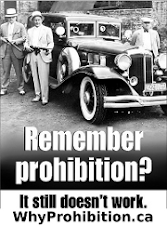
I replied to "otherguy58" on HuffPo (click to enlarge)
“He can contribute because he *has* been all of those things. Who better to learn from than somebody who has actually served jail time? It would be stupid to not listen to him, I have before and wrote about it: http://nblo.gs/4lIby
If our goal is to "correct" people then we must continually strive to improve our correctional system. We don't call it "Punishment Service of Canada" because the priority is to rehabilitate people while they serve their sentence and before they reintegrate into society. The majority of jailed offenders are not kept in jail forever, don't you believe that we owe it to ourselves to stop recidivism? I, as a Mother, want people who are released from prison to have been given the tools to never re-offend thus making the country I live in a much safer place for my children. Don't you?
The worse thing we could EVER do is make our incarceration system private and for profit - this is a public service that our hard earned taxes go to because we like having professionals in Fire and Police Departments, ambulances, jails, hospitals and mental health facilities, public schools etc. These public servants are properly trained to help us live our safest and healthiest lives. The Correctional Service of Canada is a necessary public service with the priority of public safety and therefore should forever be exempt from making profit for privately owned businesses and corporations. Making Money Off of Crime: It's Criminal!”
*****
I know taxes suck but where I don't mind mine going is toward healthcare, public safety, (cops, fireman, court and jail workers, probation officers, mental health workers* etc) education (child and youth programming throughout all communities) public transit and infrastructure (roads, highways bridges) and social services for families and people in need as lower poverty rates translate into less crime.
All of the above aid me, you, and our families every day. Public servants help to keep us healthy and safe and if something does happen to us they are there. Their goal is a job well done, not boosting their funds. All of us benefit when these different service agencies are given support and are at the top of their game. As professionals in their respective fields they contribute to effective work, policies and positive outcomes.
Private corporations could care less about the people they contain and spit out, after all, they love it when people come back for another stint. Their main objective is to make money, every new and returning prisoner raises their stock on Wall St. and taxpayers end up footing the bill. Canadians deserve to have our safety be a top priority and leaving this task to private companies is just asking for tragedy and economic failure. The Americans have been down this treacherous road, let's be smart and not follow.
*****
Excerpt from: Private prison companies look to Canada as industry faces lawsuits in US
US states are beginning to rely less on privately run prisons, but Canada may be a land of opportunity for the two biggest firms
"US private prison firms are targeting Canada for fresh opportunities as pressure builds at home on the troubled multi-billion dollar industry from human rights groups and legal actions, and as more states look to scale back their reliance on them.
Two of the biggest operators in an industry once regarded as recession-proof, Geo Group and Management and Training Corporation (MTC), have been lobbying various government departments in the Canadian capital, Ottawa.
With a massive prison overhaul plan already underway – as well as the passage in March of Bill C-10, a suite of crime legislation that most observers agree will see more Canadians face prison time and keep those already locked up behind bars for longer – it seems the American industry's interest in its neighbour to the north could not come at a better time.
The private industry's lobbying of Canadian lawmakers has some Canadian prison watchers worried. "There is something unethical with having corporations seeking profits from locking people up," wrote a group of former high-ranking Canadian justice officials to the Kingston Whig-Standard newspaper in March." ~ Read the whole article here.
*There is a higher rate of mental illness in the poor than in the rich (source Brill 40) ~ Death in Remand: Stacked Deck
"Forty-nine per cent of all prisoners admitted to a B.C. jail between 1997 and 2004 had a diagnosed mental illness. Fully half of those were also addicted to alcohol or drugs. In total, 56 per cent of provincial prisoners in B.C. during that time, both on remand and sentenced, were either mentally ill, addicted to something, or both. There's obviously a spectrum there. "Mental illness" covers a broad swath. But even still, it's hard to overlook the connection.
Remand rates are going up at least in part because of the judicial response to breaches of bail and probation condition. At the same time, the justice system is dealing more and more often with the sort of people most likely to breach.
It has to be asked: Are we setting them up to fail?"
~ Tory crime bill will make matters worse for mentally ill: expert
For anyone who didn't get a chance to watch "Prohibition" - the phenomenal 3 part documentary by Ken Burns and Kim Novick - you're in luck! PBS has gone all out and created an absolutely amazing web experience worthy of sharing so go check it out, and tell your friends!
NORML reports: "In May 1929, Pauline Sabin founded the Women's Organization for National Prohibition Reform (WONPR). It was a platform for women who were demanding the repeal of the 18th amendment forbidding the manufacture and sale of alcohol. Known as the Sabin women, the leadership of the WONPR consisted primarily of the nonpartisan wives of leaders of American industry. In a little over a year, almost 1.5 million Sabin Women were publicly calling for an end to prohibition-inspired violence and political malfeasance related to the illegal production of alcohol." ~
Jodie Emery is one of the strongest leaders in the cannabis legalization movement. Wife to imprisoned activist Marc Emery, Jodie has become a voice to be reckoned with in her own right. Mrs. Emery will also be at the front leading the Global Marijuana March alongside the NORML Women's Alliance of Canada.
*****
Follow the NORML Women's Alliance on Twitter: NORMLWomen'sAlliance - @NORML_CWA Join and "LIKE" the new Facebook Page for the NORML Women's Alliance of Canada.
* - FOR IMMEDIATE RELEASE - APRIL 27, 2012The NORML Women’s Alliance of Canada Leads The 14th Global Marijuana March The NORML Women’s Alliance of Canada is pleased to announce we have been chosen to lead the 14th Toronto Global Marijuana March(GMM) throughout the city on Saturday, May 5, 2012. The GMM takes place annually in over 100 cities across the globe and will attract upwards of 20,000 cannabis enthusiasts and anti-prohibitionists to downtown Toronto alone. We believe that women will once again be a successful, driving force towards ending prohibition. In the spirit of the day the NORML Women's Alliance of Canada has chosen to honour those women who bravely campaigned for an end to alcohol prohibition in the 1920s and ‘30s by dressing in attire reminiscent of this era. The peaceful protest will assemble at 11 a.m. and launch at 12 p.m., north of Queen's Park North at Charles Street. It will traverse north to Bloor Street, east to Yonge Street, south to Gerrard Street and east to Church Street. After the march, the crowd will disperse to several marijuana-friendly events across the city. Members of the NORML Women's Alliance of Canada are mothers, grandmothers, daughters, sisters, and caregivers of this nation. We are calling on the Canadian Government to end cannabis prohibition, re-prioritize spending to focus on our families, education, health care and a mandate to protect Canadians from being damaged any further by this harmful, tried and failed government policy. The NORML Women’s Alliance of Canada is a non-partisan coalition of socially and geographically diverse women from coast to coast to coast who believe that marijuana prohibition is a destructive and hypocritical policy that undermines the Canadian people, sends a mixed and false message to our youth, and destroys the cherished principles of personal liberty, freedom and sovereignty belonging to all Canadians. NORML Women’s Alliance of Canada
My response to this article: It's time for Canada and all nations to admit that the War On Drugs is lost, in fact, just like The Noble Experiment it could never have been won to begin with. We do not respect the laws of drug prohibition because they are unenforceable. To prohibit the use of a plant that we have used for thousands of years for medicine, relaxation, paper, food, fabric, fuel, etc. is not only unjust, but an impossible endeavor. I respect laws that are created to keep society safe from truly violent and dangerous people. As a Mother I believe a majority of police and judicial resources must be focused on those who truly pose a threat to society. But the law of Cannabis Prohibition is so ridiculous that it causes disrespect for the law and law enforcement, which is a shame because there are many great police, lawyers, judges, etc. out there who really do care about people, most notably members of L.E.A.P. ~ Law Enforcement Against Prohibition. Politicians must concede that they cannot legislate human behavior when it comes to what we eat and drink, how we medicate or what we grow in our gardens. It is the ultimate persecution of our freedom(1) of personal autonomy and wreaks of ownership! We're not perfect, we're Human, we use drugs, we always have, deal with it! The mere notion that government believes laws can stop plants from growing in the ground is ludicrous. End the Drug War that empowers and enriches cartels and organized criminals. Provide truthful facts to our children about all substances and regulate the sale of drugs to adults. Revive the farming of the Industrial and food grade Hemp plant the world over so we can help our environment and conquer famine and malnutrition. We can concentrate on more important things like our disastrous economy, health care, school boards and old and failing infrastructures. Every taxpayer dollar we spend fighting this unwinnable war is a dollar stolen from proven programs that really do help support the health and safety of all of us. When it comes to paying for helicopters flying through the air searching for plants(2) or schools and hospitals, I know without a doubt where I want my tax dollars to go!
via YouTube: David Bratzer, a police officer in British Columbia, Canada, says he has seen how marijuana prohibition and the failed "war on drugs" directly lead to the growth of organized crime and cause gruesome illegal market violence. David is a member of Law Enforcement Against Prohibition, which anyone can join for free atCopsSayLegalizeDrugs.com
"The Law Makes Us Lawless" The awesome Ken Burns and Lynn Novick documentary "Prohibition" can be viewed at PBS online.
"I, as a responsible adult human being, will never concede the power to anyone to regulate my choice of what I put into my body, or where I go with my mind. From the skin inwards is my jurisdiction, is it not? I choose what may or may not cross that border. Here I am the Customs Agent. I am the Coast guard. I am the sole legal and spiritual government of this territory, and only the laws I choose to enact within myself are applicable."
Finally posting this, the baby woke up just before I was finished and then the day went speeding by.....
1:39 A.M. - So at this late, or early depending how you see it, hour, it's up for debate on the validity of some expletive enhanced Tweets sent from NDP MP Pat Martin's Twitter Account.
Imagine that! @PatMartinMP is Human! Admit it, you've probably used that word talking about Politics.
I was watching the Bill C10 clause by clause Senate debate on CPAC and a Conservative MP complained about how long it was taking to go through it all. So I say out loud to myself (and to the oblivious baby, who's too enthralled with an Elmo book to take any exception to my cussing) with the sheer gusto that this MP is going to hear my reply to his whining:
"Well! That's what happens when you mash NINE fucking crime bills into one big whopping wad of FAIL!"
Sure he didn't catch my response, but I felt better putting my opinion out there into the Universe. Indeed, the cursing solidified my point.
Crime is complex and justice demands that each case is handled individually and fairly. We employ Judicial Discretion because it is imperative to democracy. Bill C-10 is overly broad "You bad! - Go to jail!" Cave Man thinking. It's actually dangerously stupid to treat something as important as our legal and correctional system so recklessly. You know it, Steve knows it, the media knows it, we all know it! I mean, what could be dumber than combining crime legislation?
There's a reason crime is lower in Canada than in the United States, it's because we've resisted the ideological temptation of locking up non-violent first time offenders for long periods of time when community supervision or probation would be more beneficial. It's called a Correctional System for a reason, the goal is to correct, not to make one's mental state so broken and fragile that it's no surprise when people re-offend. Not only does helping people turn their lives around make our communities safer, it is also exponentially more cost effective. (I could really get into it about the Prison Farms program here, but I digress)
Prisons are also increasingly becoming warehouses for the mentally ill and alcohol & drug addicted. With a lack of programming people are released back into our communities without the benefit of medical and psychological attention and they get into trouble all over again. Ask yourself, do you want Canadians to be helped while they serve their sentence so when they get out of prison they stay out? Or do you want people released unstable, angry and ripe for recidivism?
We've seen the social and economic disaster unfold before our very eyes in the United States over the last four decades from one size fits all persecutions and yet the Harper Conservatives still insist on careening down the same destructive path, our safety and hard earned tax dollars be damned!
Honestly, if the Conservatives had drafted really good separate bills pertaining to violent crimes, especially those committed upon children, then I would wholeheartedly support them. I don't play to party lines when it comes to the best method of keeping our kids safe and reducing crime. I want the smartest, most effective laws on the books for the benefit of my own kids and my fellow Canadians. Alas, because C-10 is a "Everything plus the kitchen sink" omnibus bill the only smart, logical, reality-based choice we have is to fight against it.
Anything less would be fucking criminal.
"It represents a huge step backwards; rather than prioritizing public safety, it emphasizes retribution above all else. It's an approach that will make us less safe, less secure, and ultimately, less Canadian."~ From "Bar association blasts tough-on-crime bill" ~ Organization representing Canada's lawyers says proposed Bill C-10 has been rushed, ignores evidence and will create out-of-control costs
After Christy Clark said she supports Harper's Crime Bill, a group of 40 concerned citizens organized by http://www.LeadNow.ca gathered in front of her office to "Just Say NO to C-10!" and show that tens of thousands of Canadians have signed a petition opposed to this omnibus crime bill. As of November 17th, 111,000 Canadians have signed the petition! Sign the petition and get updated on future activities at http://leadnow.ca/
"The United States is the world's leader in incarceration with 2.3 million people currently in the nation's prisons or jails -- a 500% increase over the past thirty years. These trends have resulted in prison overcrowding and state governments being overwhelmed by the burden of funding a rapidly expanding penal system, despite increasing evidence that large-scale incarceration is not the most effective means of achieving public safety."
"In addition to the extreme human toll this is taking on our Nation, the financial costs are staggering: The National Association of State Budget Officers estimates that states spent a record $51.7 billion on corrections in FY2008, or 1 in every 15 general fund dollars. Adding local, federal and other funding brings the national correctional spending total to $68 billion. This is money that cannot be spent on education, health, transportation, or other projects that benefit society as a whole." ~ NAACP Supports Legislation To Help States Reduce Prison Population
Me! Okay, while I don't have a big advertising budget to create and air, not an "Attack Ad", (Those are just so.... UNCanadian, to me) but a Truth Ad, I thought I'd utilize the Power of The Internets to share a spot on video with my fellow Canadians highlighting the Conservative push to replicate the failed American War on Drugs*.
The following was originally created by the Drug Policy Alliance in the United States. Marc Emery paid for a Canadian version for the last Federal election as Stephen Harper and the Conservatives have been pushing their Stupid On Crime Agenda for many years now.
"INCARCEREX" - Do not mix with The Charter or Common Sense.
Chances are (If we're lucky!) there's an election coming this Spring** and Canadians have to decide just where our priorities lie. Ask yourself: "What do Canadians need more? Money for Education, Health, Child and Elder Care, Infrastructure, (Which will also create jobs, we all use roads and bridges, lets make them safe & smooth!) the Environment, etc? Or do you want to copy failed U.S. Drug War policy, and shovel BILLIONS AND BILLIONS of your hard earned tax dollars towards building and operating prisons, especially at a time when crime is at a 30 year low and we're SIXTY BILLION dollars in debt? (See the Canadian Debt Clock to your right--->)
And FYI, for all the bleating the Conservatives put forth about being the only party who care about victims of crime, let us be reminded that in 2010 the Tories slashed Grants for the Victims of Crime Initiative by 43% & the Contributions to the Victims Of Crime Initiative by 34%. Please also read the Globe and Mail article: Canada warned not to follow U.S. tough-on-crime ‘mistakes’, although, I'm sure the Conservatives will stupidly continue to ignore the advice from our neighbours to the south. #FAIL
*****
"What purpose does it serve the Conservatives to quash judicial discretion? To disregard evidence and research that clearly demonstrates that Mandatory Minimum Sentencing is ineffective, expensive and a fallacious approach regarding drug policy and criminal legislation? I ask my fellow Canadians, "Are YOU comfortable with the knowledge that your government blatantly ignores the findings of our very own Justice Department?" ~ Con Job! Tories Ignore Justice Department Reports
****
*the Conservatives are refusing to allow Canadian taxpayers to be privy to the estimated costs of Bill S-10 along with other crime bills citing "Cabinet Confidence", and the Opposition just may call the Tories out with a vote of non confidence. **War on Drugs ~ AP: Billions Spent Had Meager Effect In 40-Year War On Drugs
An Associated Press analysis of America's 40-year war on drugs concludes that the country's costly effort has met virtually none of its goals. In 1970, when President Richard Nixon signed the Comprehensive Drug Abuse Prevention and Control Act, he declared drug abuse "public enemy No. 1 in the United States" and promised to wage an "all-out offensive." His first drug-fighting budget was $100 million. Now it's $15.1 billion, 31 times Nixon's amount even when adjusted for inflation.
The AP tracked where that money went and found that the United States repeatedly increased budgets for programs that did little to stop the flow of drugs. In 40 years, taxpayers spent: $20 billion to fight the drug gangs in their home countries, including $6 billion in Colombia; $33 billion in marketing "Just Say No"-style messages to America's youth and other prevention programs; $49 billion for law enforcement along America's borders to cut off the flow of illegal drugs; $121 billion to arrest more than 37 million nonviolent drug offenders, and $450 billion to lock those people up in federal prisons alone.
CON JOB: verb-transitive ~ To swindle (a victim) by first winning his or her confidence; dupe.–noun ~ A swindle. –adjective ~ Of, relating to, or involving a swindle or fraud: a con artist.
ALARMIST: person or group/organization who needlessly alarms or attempts to alarm others, as by inventing or spreading false or exaggerated rumors of impending danger or catastrophe.
In a cheap attempt to sway uninformed Canadians into voting for them, the Conservatives continue to be alarmist, trying to convince you that Canada is bursting at the seams with dangerous criminals lurking on every corner like a Boogeyman in your closet. Harper, Toews, Nicholson, Glover et al want you quivering, believing that no one can save you and your family from becoming victims except for the "Tough on Crime!" party! The kicker? Crime has actually been declining in Canada, in fact, crime rates fell by about about 3% in 2009 — 17% lower than a decade ago. Joseph Neuberger puts some context to this: "The last time Canada's crime rates were as low as Statistics Canada says they are now, The Sting and American Graffiti played at the movies; Pink Floyd's Dark Side of the Moon ruled the airwaves and M*A*S*H was tops on TV." (Please read the whole awesome article Tough on Crime Bill Is Tough on Us All)
The following is from a previous post I wrote called "Calling the Tories Out on Bill C-15 - "The Politics of Fear". This information is applicable to Bill S-10 and deserves to be highlighted as the Conservatives continue to attempt to label the opposition as *soft on crime and pull one over on Canadians who are unfamiliar with the consequences of Mandatory Minimum Sentencing from drug offenses:
The judiciary in Canada and elsewhere are opposed to mandatory sentences of imprisonment. The Canadian Sentencing Commission (1987) found in their survey of judges that slightly over half felt that minimum sentences impinged on their ability to impose a just sentence and that inappropriate agreement between defense and Crown counsel may result.
The future of mandatory minimum sentences in Canada remains unclear. There is some indication that minimum sentences are not an effective sentencing tool: that is, they constrain judicial discretion without offering any increased crime prevention benefits. Nevertheless, mandatory sentences remain popular with some Canadian politicians.
Where mandatory sentences do exist, they have been the object of considerable (and growing) opposition from a variety of parties, including advocacy groups, judges, academics and criminal justice professionals. This opposition has led to a number of Bills to amend or repeal the mandatory sentences legislation. While a number of countries have passed mandatory sentencing legislation within the last decade, there is evidence that jurisdictions with the most severe mandatory sentencing laws are beginning to repeal, or consider repealing, the most punitive sentences of imprisonment.
Trends in Mandatory Sentencing Legislation - After a decade in which a number of common law countries enacted mandatory sentencing legislation, there is clear evidence that several jurisdictions are now either repealing or amending these punitive laws. For example, in 2002 the Michigan mandatory sentencing laws were significantly amended. The effects of these amendments include the following:
• elimination of mandatory minimum sentencing for certain controlled substance violations; • creation of provisions that permit courts to consider important mitigating factors; and • revision of the quantities of drug that trigger certain sentences.
This movement towards a more flexible, judge-determined sentencing scheme is a result of several factors with international repercussions including:
• a shift in public opinion away from supporting strict mandatory minimum sentencing (see above); • the impact of Advocacy groups such as Families Against Mandatory Minimums Foundation (FAMM); • growing public disenchantment with the “War on Drugs” that initially triggered many of the most punitive mandatory sentencing laws (see Eagleton Institute of Politics Center for Public Interest Polling, 2004); • news media coverage of “three-strikes” cases in which offenders whose “third strike” consisted of a less serious felony and stories of offenders receiving lengthy prison terms for offenses such as stealing a bicycle from a garage have undermined public support for this kind of sentencing; and • growing concern among criminal justice professionals that mandatory sentences have played an important role in keeping prison populations from declining, even in an era of falling crime rates.
Mandatory Sentencing and Public Opinion - Although this report deals only with the statutory regimes with respect to mandatory sentences of imprisonment, it is worth noting that there is evidence from a number of jurisdictions that public support for mandatory sentencing has declined over the past decade. Mandatory sentences of imprisonment represent the most punitive sentencing reforms of recent years and are found in many western nations. Often justified by reference to public opinion, they have proved highly controversial in practice. Where do members of the public stand with respect to the issue? Few studies have addressed public knowledge of statutory minimum penalties; fortunately, the surveys that exist on this issue have generated the same findings: the general public has little knowledge of the offenses that carry a mandatory minimum penalty, or of the magnitude of the statutory minima. For example, in 1998, members of the public responding to the British Crime Survey (BCS) were asked if they were aware of the mandatory minimum prison term of three years for offenders convicted of burglary (see Roberts, 2003).
Even though this mandatory sentence had been the object of considerable media attention, less than one quarter of the sample responded affirmatively. This finding is consistent with earlier research in Canada that found that very few members of the public had any idea which offenses carried a mandatory sentence (Roberts, 1988 - It should not be surprising that public knowledge of mandatory sentences is poor. Opinion surveys conducted in several jurisdictions have shown that the public knows little about maximum sentences, sentencing options, alternatives to imprisonment, sentencing patterns, recidivism rates, or many other elements of the sentencing process (see Roberts and Hough, 2005, for a review). For example, respondents may overlook the fact that mandatory sentences of imprisonment violate important sentencing principles such as proportionality in sentencing. In addition, mandatory sentences of imprisonment may prove expensive by increasing the costs of the correctional system as more offenders are admitted to custody (and for longer periods of time).)
There is clear evidence that even in the United States, where support is stronger for mandatory sentences, public support for the concept is declining. For example, in 1995 over half of the sampled public in the US held the view that mandatory sentences were a good idea (Roberts, 2003). In 2001, this percentage had declined to slightly more than one-third of respondents (Peter D. Hart Research Associates, 2002; Roberts, 2003). In fact, over half the polled public in the US now favour the elimination of “three-strikes” mandatory sentences (Peter D. Hart Research Associates, 2002). The most recent polling on the issue of mandatory sentencing comes from the state of New Jersey. When asked whether mandatory jail or mandatory drug treatment was the more effective approach to non-violent offenders, respondents chose treatment over imprisonment by a three to one ratio (Eagleton Institute of Politics Center for Public Interest Polling, 2004). Three-quarters of the sample favoured allowing judges to set aside mandatory sentences “if another sentence would be more appropriate” (Eagleton Institute of Politics Center for Public Interest Polling, 2004).
The Future of Mandatory Sentencing - It would be overstating the case to say that the pendulum has swung away from mandatory sentencing to a model of sentencing that privileges judicial discretion. However, it is clear that public and legislative interest in mandatory sentencing laws has declined, and is likely to continue to decline in the near future. Although the public supports tough sentencing measures for violent offenders, the experience with mandatory sentencing legislation in a number of countries has shown that these laws do little to promote public confidence in the sentencing process.
This report has demonstrated that while mandatory sentences of imprisonment proved popular in the 1990s across a number of common law jurisdictions, closer examination of the laws reveals that many countries allow courts the discretion to sentence below the minimum when exceptional circumstances exist. This usually means that courts are permitted to consider mitigating factors relating to the offense or the offender, in some cases, as long as the judge provides written reasons for doing so. In addition, while the general public appears to favour the use of mandatory sentences for offenders convicted of the *most serious offenses and repeat offenders, there are important limits on public support for strict mandatory sentencing laws. When the public is provided with more information regarding the law and the circumstances surrounding the offense and the offender, the tendency is not to favour punitive sanctions such as mandatory minimum sentences.
*most serious offenses ~ s. 718.1 of the Criminal Code of Canada states: "sentences should be proportionate to the offense and reflect the degree of responsibility of the offender."
Thomas Gabor, Professor Department of Criminology University of Ottawa Nicole Crutcher Carleton University Research and Statistics Division January2002
An excerpt from section 5.4 Mandatory Sentences for Drug Offenses states:
Some of the most sophisticated research in this area has been undertaken at the Rand Corporation (Caulkins et al., 1997). Through various mathematical models, Rand researchers compared the cost effectiveness of various drug prevention/control strategies, including lengthy MMS. Their analysis considered the cost of each strategy and the expected yield in terms of both drug consumption and crime reductions. Their conclusion was that conventional sentences imposed on dealers are more cost effective than long MMS reserved for fewer offenders and that treating heavy users is more cost effective than either approach in lowering drug use or drug-related crime. MMS were found to be the most cost effective strategy only in the case of the highest level dealers; however, the low thresholds at which MMS tend to kick in means that these laws are more likely to ensnare low-level offenders. Also, high-level dealers are more likely to avoid MMS, as they are in a better position to have information to trade for an exemption from these penalties. Finally, these investigators note that the time horizon of evaluations is critical, as MMS become less cost effective over time.
Hansen (1999) asserts that the tide is turning against MMS for drug infractions. He notes that they have done little to reduce crime or to put large-scale dealers out of business. Rather, they have filled prisons with young. low-level, non-violent individuals at great cost to taxpayers. Hansen points out that, in Massachusetts, 84% of inmates serving mandatory drug sentences are first-time offenders.
...MMS fail to discriminate between these hardcore drug dealers and those who feel compelled to sell due to an addiction or difficulties encountered in participating steadily in the work force. The implication is that employment opportunities, more accessible drug treatment, and alternative sentences would be preferable to the “iron fist of the war on drugs.”
Harsh MMS and the “drug war” approach in general show little effect in relation to drug offense. Judges routinely circumvent the “mandatory” death sentences for drug trafficking in Malaysia and the tough MMS in the US have imprisoned mostly low-level, nonviolent offenders. MMS do not appear to influence drug consumption or drug-related crime in any measurable way. A variety of research methods concludes that treatment-based approaches are more cost effective than lengthy prison terms. MMS are blunt instruments that fail to distinguish between low and high-level, as well as hardcore versus transient drug dealers. Optimally, it would appear that tough sentences should be reserved for hardcore, high-level dealers, while treatment may be more appropriate for addicted dealers and employment opportunities may be more cost effective in relation to part-time dealers who are underemployed.
Conclusion: 9.5 Mandatory Sentences for Drug Offenses
Severe MMS seem to be least effective in relation to drug offenses. Studies using a variety of methodologies seriously question the value of the “drug war” approach. The draconian penalties in Malaysia are routinely circumvented by the judiciary and the tough MMS in the US (both at the state and federal levels) have imprisoned mostly low-level, nonviolent offenders. Drug consumption and drug-related crime seem to be unaffected, in any measurable way, by severe MMS. Both mathematical modeling techniques and field work arrive at the conclusion that treatment-oriented approaches are more cost effective than harsh prison terms.
9.9 Concluding Remarks
From a utilitarian point of view, incarcerating occasional, non-violent offenders, for substantial periods, constitutes a colossal waste of justice system resources.
...Therefore, MMS should not be introduced merely to placate a political constituency or without regard to a thorough understanding of the infractions or offenders for whom they are intended. ~ Fin
*****
"Discretion is a science of understanding, to discern between falsity and truth, between wrong and right, between shadows and substance, between equity and colourable glosses and pretenses, and not to do according to their men's will and private affections." ~ Justice Edward Coke
*****
What purpose does it serve the Conservatives to quash judicial discretion? To disregard evidence and research that clearly demonstrates that Mandatory Minimum Sentencing is ineffective, expensive and a fallacious approach regarding drug policy and criminal legislation? I ask my fellow Canadians, "Are YOU comfortable with the knowledge that your government blatantly ignores the findings of our very own Justice Department?"
Prevention. It's worth more than a pound of Tory rhetoric for Canadian families and hard working taxpayers. Lets ignore the Con Job, Canadians, of course we are all concerned about crime, but lets be brave and approach solutions to keeping our kids and communities safer by being smart, logical and realistic about crime policy.
Ignoring evidence that clearly proves that Mandatory Minimum Sentences escalate crime and violence in our neighbourhoods? Now that's scary!
Fortunately, we can see what has happened in the United States when a government is "Stupid on Crime" because they don't want to be labeled "Soft on Crime".
*****
“Still, my own personal view is that it’s a mistake to take away discretion from judges, In the last couple of decades, the U.S. has gone the way of mandatory sentencing for a whole bunch of crimes and the result is their prisons are jammed.
I find it hard to understand how the richest country in the world has one of - if not the - highest prison population in the world. There’s something wrong there, and the problem is mandatory sentences. I’m disappointed to see Canada drifting in that direction.” ~ Retired Quebec judge John Gomery
*****
*soft on crime ~ From: It's a 'myth' Canada is soft on crime It is a myth that Canadian courts are soft on crime and that the Charter of Rights is responsible for criminals escaping conviction or receiving light jail terms, says Canada's chief justice, Beverley McLachlin.
The Charter of Rights, signed on April 17, 1982, as part of the repatriated Constitution, gave judges the power to not merely interpret laws, but to strike them down if they were found to violate any of the established rights.
They include freedom of religion, expression and association, the legal right to life, liberty and security of the person, and the right against unreasonable search and seizure. Equality guarantees, including freedom from discrimination based on age, sex, race, or disability, came into effect in 1985.
Have you seen this, for lack of a better word and a chance of sounding crass, BS? Oppose Legalizing Marijuana (Prop. 19)
From marijuanaharmsfamilies.com:
"Marijuana bosses are moving beyond "medicinal marijuana" and now want to usher in a FULL-BLOWN marijuana culture to forever change California (Prop. 19). They want the next generation to think it's "normal" to "get high"!"
"Studies show marijuana is a gateway drug to cocaine and meth. Teens and young adults are especially at risk from today's potent, mind-altering marijuana, which can permanently damage their developing brains and young lungs. If pot is legalized, your health and auto insurance will likely cost more because increased addictions, accidents, and drug rehab will burden all Californians. “Drugged driving” will become commonplace. It will be a new "right" to get high on marijuana at work, even in transportation jobs. Marijuana legalization means cities and counties can OK selling pot in grocery stores and permit marijuana operatives to buy thousands of acres of farmland. " -
"Marijuana Operatives!" "Marijuana bosses?" "Gateway to Crystal Meth!?" Please!
As we head towards November 2nd. and the vote for Prop 19 initiative to legalize cannabis for adults on the California ballot, please take heed of the rampant propaganda running amok. While there's so much ignorance and misinformation in this video that it would take me quite awhile to break it all down, I'd like to point out this particular thorn: the main reason for the high numbers of young people in rehab for cannabis is because once busted for pot possession they are often presented with two choices: Go to Rehab or go to Prison. Which one would you choose? Also noted is that the ability to rate and comment features have been disabled for this video. Convenient eh.
So, being irked I decided to do a little googling about the group marijuanaharmsfamilies.com and came upon SaveCalifornia, an arm of SaveAmerica and the Campaign for Children and Families, responsible for posting the video.
"SaveCalifornia.com is your pro-family organization dedicated to defending and representing the values of parents, grandparents and concerned citizens who believe in family, faith and freedom. Based on the Left Coast, SaveCalifornia.com, along with our national arm, SaveAmerica.com, works, leads and fights in the media, culture and government on behalf of marriage and family, parental rights, the sanctity of human life, religious freedom, financial freedom, and real education for children."
Along with fighting Prop 19, the Savers also supported Prop 8 and release statements like:
"This is just the beginning of this new, blatant and perverse indoctrination of children via Harvey Milk Gay Day. “Milk Day” is designed to teach children they may be homosexual, bisexual or transsexual, and that they should support political activism to destroy marriage and family and religious opposition to the harmful “LGBTQ” agenda. It will increase even more next year, and then Harvey Milk’s indoctrination will manifest in many more government schools in 2012 when May 22 finally falls on a school day, Monday. Parents and grandparents, I plead with you to rescue your children and grandchildren from immoral education and awful peer pressure. Harvey Milk Gay Day is just one of 6 school sexual indoctrination measures passes in the last several years. And there’s a raft of other pressing reasons to save children from government-run schools."
Randy Thomasson of the Savers and the Campaign for Children and Families once compared county clerks who offer marriage licenses to same-sex couples to "Nazi officers during WWII [who] had been ordered to gas the Jews."
Really.
Thomasson blames the acceptance of cannabis, gay rights, and a womans right to choose on "dumbed down" voters and government (Public) schools:
"DUMBED-DOWN VOTERS - Elections used to be about what kind of government we would get. Now I think elections are more about what kind of people we are. Hear me on this. Most voters went to government schools where knowledge of the written United States and California Constitutions are NOT taught. Nor are the historical Christian convictions of our founding fathers and the Judeo-Christian foundation of the U.S. Constitution. Instead, most government school graduates are taught that God should be kept in the closet, that evolution is fact, and that feelings are as important, as or even more important, than hard facts (which is why some school districts don’t even give A-F grades anymore). Ignorance makes people easy prey."
Californian voters, he says "are not as virtuous or morally principled as they used to be."
"Today, the main influence upon the minds and hearts of children is government schools, with dumbed-down academics, political correctness, anti-God and anti-morality sentiments, negative peer pressure and now even hints of socialistic teaching. Public schools these days don’t teach the Christian foundation of our government, which is why many voters today support immorality and socialism. The best thing parents and grandparents can do for their children and grandchildren is to permanently remove them from the government school system so they can develop good character, critical thinking and learn to stand for truth."
"FACT: California laws have changed so radically in the last few years, your child WILL be sexually indoctrinated and subjected to very negative influences if left in the government school system. Take action. Rescue your child now, before it's too late." ~ rescueyourchilddotcom, a project of SaveCalifornia
The Savers want you to:
"Target the culture: Work to change the culture at the same time you work to reform the government. Encourage more parents to home-school. Invite union workers to resign from the anti-family unions so they don’t fund anti-family, anti-life political candidates or campaigns. Promote sexual abstinence among church children and all schoolchildren, and sexual purity in general. Work to clean pornography out of your community. Visit employers to encourage them to promote man-woman marriage in their businesses for the benefit of their product/service as well as their employees." as highlighted in their missive 10 WAYS TO BUILD A PRO-FAMILY ARMY.
"Hold regular meetings" they say.
"Consider a bi-weekly movie night where you show a patriotic or spiritual message or "classic film with a message" (*Reefer Madness, perhaps?) movie in a large house or church hall. Bring the DVD and popcorn, and provide a brief introduction and lead a discussion afterward to educate and provide examples from the movie. This is where you sign up more people to join your army. Sign up teenagers too and make sure you have them join your email list, mailing list, Facebook and Twitter pages, if you have them."
They highlight videos from single mothers, one with 7 kids who says marijuana addiction(!) destroyed her life. (Even though she was doing crank and meth and continuing to have kids - but yeah, it was all the fault of the "evil gateway drug" marijuana.) She herself stated she made bad choices.
Whatever happened to personal responsibility? Cannabis doesn't make you try harder drugs, never once have I ever puffed on a joint and thought "Hey! Now I gotta try me some heroin!". Her own decisions and choices led to her addiction of hard drugs - not cannabis, it's like blaming Twinkies and KFC Double Downs for that extra 10 pounds you gained, not the fact that you chose to shove them down yer piehole.
Even though I'm an Atheist I'm not anti-religion in the sense that if people want to believe in a god that's their perogative and who am I to say what you should believe or who you may believe in. Some of my very best friends in the whole world are very religious, one is even married to a pastor and teaches Sunday School, the difference between them though and the Randy Thomasson's of the world is that they aren't condemning everyone who does not think like them as deviant sinners. Judgy Judgersons belonging to any religious brigade who profess diatribes like "It's our way or way or the highway, veer away from our conservative status quo and yer evil and trying to bring society down!" just seems so... blasphemous** to me....
I'm also not "anti-family", I'm a married mother with 5 wonderful sons and promote strength in the family unit - however that unit is made up. I am for personal autonomy and freedom. People have the right to love who they love right along with what substances they ingest. I don't need a zealot like Randy Thomasson inciting hatred in the name of a god and telling me how to vote, and certainly not how to raise my children!
I teach my kids love, compassion, tolerance, respect, responsibility and acceptance - they know not everbody is the same and being different is what makes all of us special in our own way. Now that's a part of building a strong family unit. And wouldn't you know it, I came up with those values all on my own, because that's just a part of being a good parent, and a good person, regardless of religion.
So. Voting, Gay, Atheist, Pro-Choice, Cannabis Consumers With Kids Attending Public Schools in California and the People Who Love You for Who You Are - you are officially SaveAmerica''s #1 Enemy. Take that info with you into the voting booth on November 2nd. Just Say Now and be the generation who ends destructive Cannabis Prohibition!
C'mon now, Mama said.
*****
"So many things in life come down to people making personal decisions for themselves. We don't always make the best choices, but such is life, and each experience - great or small, right or wrong, happy or sad - shapes the person we become. Everyone has regrets and can question their actions (did I really wear that top to that party back in grade 11? What was I thinking??!!??) and hindsight is 20/20. But that is the beauty of life, it's a journey, sometimes it's bumpy and sometimes it's smooth sailing and in the end each of us owns the road we've travelled down. There are different views of "The Meaning of Life", and no two people have the exact same philosophies and I think that's wonderful, otherwise this would be one really boring existence. What would be the point of a life with no individuality and no personal autonomy? The geek in me rejoyces that we are not living in Hives of The "Borg" - I subscribe to a more "Browncoat/Independent/Resist The Alliance" way o' life."
The Borg is a collective, meaning that they—or it—possess a single mind. That Borg mind has the single intent of “assimilating” all organic species into the collective. The Borg are utterly without mercy or compassion. In a collective society only the needs of the group as a whole are considered, and in this utilitarian calculation the needs of the unrivaled number of Borg will nearly always override any other considerations.
The Alliance (from Firefly/Serenity)
A scene at an Alliance school, where a teacher sadly muses that it's hard to understand why the benighted Independents, the secessionists, have resisted the attempt to bring them the gifts of civilization. Young River Tam knows:
"We meddle... people don't like to be meddled with. We tell them what to do, what to think, don't run, don't walk. We're in their homes and in their heads, and we haven't the right. We're meddlesome." ~ River Tam
~MaryJane Cannabian, from my post Science Trumps Ideology
*****
*(Reefer Madness, perhaps?) - My suggestion, mwahahahaha.
**the Latin Vulgate employs the word blasphemare to designate abusive language directed either against a people at large (2 Samuel 21:21; 1 Chronicles 20:7) or against individuals (1 Corinthians 10:30; Titus 3:2).
Do the police have nothing better to do than raid Compassion Clubs that help sick people? Have all the murderers and rapists and domestic abusers and paedophiles been caught in Quebec that shutting down Cannabis Dispensaries are the police priority?
Cannabis has never killed anyone but Big Pharma drugs have - should we be forced to take these narcotics where the side effects include death? BTW, legal prescription medications are the 4th. leading cause of death in Canada, including deaths in hospital settings - but Cannabis is the "bad" drug? The hypocrisy is astounding.
And please, for everyone here commenting and voicing their disapproval about Cannabis prohibition, please contact your MP about Bill S-10 - the Tories are trying to introduce even tougher laws for Cannabis: "Bill S-10 ~ New Name For Bad Law"
"The principle of compassion lies at the heart of all religious, ethical and spiritual traditions, calling us always to treat all others as we wish to be treated ourselves. Compassion impels us to work tirelessly to alleviate the suffering of our fellow creatures, to dethrone ourselves from the centre of our world and put another there, and to honour the inviolable sanctity of every single human being, treating everybody, without exception, with absolute justice, equity and respect.
It is also necessary in both public and private life to refrain consistently and empathically from inflicting pain. To act or speak violently out of spite, chauvinism, or self-interest, to impoverish, exploit or deny basic rights to anybody, and to incite hatred by denigrating others—even our enemies—is a denial of our common humanity. We acknowledge that we have failed to live compassionately and that some have even increased the sum of human misery in the name of religion.
We therefore call upon all men and women ~ to restore compassion to the centre of morality and religion ~ to return to the ancient principle that any interpretation of scripture that breeds violence, hatred or disdain is illegitimate ~ to ensure that youth are given accurate and respectful information about other traditions, religions and cultures ~ to encourage a positive appreciation of cultural and religious diversity ~ to cultivate an informed empathy with the suffering of all human beings—even those regarded as enemies.
We urgently need to make compassion a clear, luminous and dynamic force in our polarized world. Rooted in a principled determination to transcend selfishness, compassion can break down political, dogmatic, ideological and religious boundaries. Born of our deep interdependence, compassion is essential to human relationships and to a fulfilled humanity. It is the path to enlightenment, and indispensable to the creation of a just economy and a peaceful global community." ~ The Charter for Compassion
Already in 2010 several medical marijuana compassion clubs have been raided by police in Iqaluit, Guelph, Toronto, Montreal, and Quebec City. Staff have been given or threatened with criminal trafficking charges. Patients unfortunate enough to be inside at the time of the raids have been detained, questioned, and charged for attempting to access medicine that has been produced safely and responsibly. The clubs have had their contents confiscated, crippling their ability to conduct business, and more importantly denying patients safe and secure access to medication.
Canadian Students for Sensible Drug Policy (CSSDP) is firmly opposed to these raids. We are firmly opposed to the use of police enforcement against the only real challenge to organized crime, responsible regulation. CSSDP is firmly opposed to the war on drugs, as it has clearly become a war on the sick, a war on youth, a war on people of colour and people living in poverty, a war on communities in Canada and around the world.
Compassion clubs exist because the Canadian government has refused to update the Medical Marijuana Access Regulations so that the regulations work for patients, and not against them. Thousands of Canadians who use cannabis medically depend on compassion clubs for secure access to safely and responsibly produced medicine. Why? One reason is because Health Canada only offers one strain of cannabis, despite the fact that there are hundreds of varieties, with differing benefits, which treat different ailments.
Robert Ling, president of the McMaster CSSDP chapter is one of these Canadians who depend upon compassion clubs for safe access to safe medicine. When asked about the raids, he stated
“The raids going on throughout Canada are a travesty for anyone who needs medicinal cannabis. I waited 12 weeks for my last MMAR renewal, so I had to live in fear, worrying that a trip to a compassionate center to get the medicine my doctor has prescribed may end me up in jail. This is another example of how medical cannabis users are discriminated against. The Canadian government and police departments all over Canada have to realize that jailing sick Canadians gets us nowhere. A lot of people, like myself, are productive because of the cannabis they use. Without this vital medication, I am usually bed ridden and forced to live out my day in extreme pain. Cannabis has allowed me to be productive through some of the worst pains I have experienced in my life. I was able to finish two years of intensive university school work in part thanks to this drug. Disabled Canadians deserve a productive life like everyone else and this definitely is not the case when we raid compassionate centers which provide sick Canadians the medicine they need. Raiding compassionate centers will only force sick people like me to go back on the streets picking up the medication we need from black market sources. This has to stop!”
Compassion clubs provide a necessary medical service for thousands of Canadians. CSSDP calls for an end to these raids and that there be appropriate legal protection for medical marijuana compassion clubs. ~ Originally published HERE, please visit their website for more great links and info regarding Canadian Drug Policy.
This is a tragedy - no one should ever be put to death for Cannabis! Cannabis is a plant less harmful than alcohol, tobacco and many prescription narcotics that is not worth much - it is only made valuable because of its prohibition. If Government regulated its sale people would not sell it in the black market.
Cannabis is also a medicine that has been used for thousands of years and indeed has helped many people overcome pain from cancer treatments. Cannabis Hemp is also valuable as a food, fabric, paper, textile and biofuel and should be used the world over to help our environment. Shen Neng first wrote about Cannabis in China over 2700 years ago and it is disrespectful to our ancestors to shun and criminalize and kill people over a plant that used to be such an integral part of our lives.
People have been using Cannabis for thousands of years and no laws will ever stop Mother Nature from growing it, or people from using it. The smart thing to do is regulate it so organized crime can no longer profit from its sale.
It is time the "War on Cannabis" is ended and we set all Cannabis prisoners free - it is just not right to kill people over a plant! ~MaryJane Cannabian
I left a comment on the National Post website after reading the brilliant article "Canada's inhumane prison plan" by Conrad Black in todays edition. I've extended it here though to add even more links and info.
I'm thankful that Mr. Black has addressed the Consevative "Tough on Crime!" agenda, it is a subject deserving of the attention of all Canadians. (And just an FYI - over the past 19 years crime in Canada has been declining after a spike in 1991.) As a non-violent offender in an American jail, I believe his POV is something we should take into consideration as the Tories are following down the road of US style Mandatory Minimum Sentences and are also disregarding the time people spend in the harsh conditions of Canadian Correctional Remand Centres. ( Under the newly passed Tory legislation *Bill C-25, remand time will become longer than sentenced time — though remand inmates are still considered to be innocent until proven guilty. There have been preliminary estimates that the total price tag will be between $7 billion and $10 billion over five years. A majority of the costs fall on the provinces.
The Conservatives are blatantly playing "The Fear Card" which would surely make Harry J. Anslinger proud. In Canadian politics the fear-appeal is becoming increasingly rampant and widespread. I ask you to remember the following: whenever you hear any person in a position of legislative power and that person (or party) agitates the public's fear of crime and proposes that supporting a bill will reduce the perceived threat, he or she may be using this tactic as a means to induce fear and to imply that other people or parties are not concerned with crime and community safety.
“Since the Canadian government justifies this criminalization, in part, as a means of protecting our youth, we are standing up and saying, ‘not in our name.’” ~ Canadian Students for Sensible Drug Policy
MP Mark Holland: "The Harper government claims to be "tough on crime," but their discredited U.S.-style policies on crime and punishment are making Canadians less safe.
Their ineffective and costly plan, entitled A Roadmap to Public Safety, should more accurately be entitled A Roadmap to Public Disaster.
Modelled after failed American policies even diehard Republicans now admit are an abject failure, it will result in more prisons and longer sentences, while doing nothing to reduce recidivism. When over 90% of the prison population will be released, the Harper government's failure to seriously invest in vital programming needed for rehabilitation and reintegration, including substance abuse treatment and mental illness care, is nothing short of reckless." -
I'd also like to add that the Consevatives have not produced any evidence or research that proves these "Tough on Crime" measures are effective in keeping people safer or reducing crime. Our neighbours to the South have been down this failed road.... why would Stephen Harper want to follow down the same doomed path, and at great expense to Canadian Taxpayers? (Read "House passes billions of dollars in crime bills, doesn’t know full costs")
I'm no bleeding heart either, I'm a firm believer in harsh and long punishment for criminal perpatrators that truly deserve it - for convictions of murder, rape, vehicular manslaughter, domestic and child abuse, paedophelia, child abduction, etc. - crimes that truly harm the physical and emotional well being of our fellow human beings. But the Tories are not distinguishing the difference between violent criminal acts and non-violent offenses. They are lumping all acts together 'cause you know, that "CRIME!" word is super scary and it's a great vote getter too. They are depending and praying on your fear. Please don't be fooled.
"When you come to these kinds of issues, I think a good deal of humility is in order. These reforms have stood the test of time. It was for later generations of politicians to take a more incautious, exclusive, dogmatic stand to treat other opinions as if they were, if not illegitimate at least somehow "beyond the pale," and they polarized opinion. To the extent that opinion was polarized by those, if I may put it this way, on the left, it provoked an equal and opposite reaction from those on the right — wedge issues. Then we come to a situation in which one group of politicians is pointing a finger and saying, "They are soft on crime" with another group saying, "These fellows are hangers and floggers."
It is lunacy. If one hears people saying those things in Parliament, in Canadian politics, about each other, you know you are listening to lunatics. There is no other way of putting it. It is nuts." ~ Senator Murray
Honourable senators, this issue of Bill C-25 is a serious one. Surrounding this bill there has been a lot of — I will use a word that I do not like to use on the Senate floor — "politicking," which is essentially concentrating attention on political slogans instead of looking at the merits of the bill. My intention this afternoon, in reply to Senator Wallace, is to concentrate on the merits of the bill and avoid any politicking or political slogans.
The problems I have with this bill are threefold. The first one relates to the Charter. This bill has three serious Charter implications. I am not inventing them for honourable senators this afternoon; I draw those conclusions from the testimony of five experts that we heard. I will quote from them later in my intervention this afternoon.
Second, this bill will have a serious impact on the condition prevailing in the prisons for the inmate population and the staff that is there to maintain order and serve them.
Third, this bill will affect drastically the most vulnerable in the prison system, namely, people suffering from mental disorders, Aboriginal people and women. As an aside on the bill's impact, we heard from the president of the Canadian Association of Crown Counsel that it will clog the bail courts. That is not the impact that is wanted by those who drafted the bill. I totally recognize the objectivity of their intentions, but that impact is what we heard from the expert witnesses.
Let me return to my first point: This bill will have serious impact on the Charter and will be open to challenge in the courts.
As senators, it is one of our duties, when we are called upon to support the bill, to question its implications for the Charter. In the respected intervention of our esteemed colleague, Senator Wallace, neither yesterday nor today did he answer those issues that were raised by the witnesses, which the honourable senator well knows — as do Senator Nolin, Senator Angus and Senator Carignan, who sat during the long hours that we spent studying this bill.
Honourable senators, let me report what we heard from those experts. First, we heard from Michael Spratt of the Criminal Lawyers' Association that:
Bill C-25, if passed, will result in constitutional litigation. Bill C-25 offends the Charter. It will have the real effect of doing something that we do not seek to do in sentencing. In sentencing, we seek to treat like offenders who commit like offences in similar ways.
One can imagine a number of scenarios where like offenders who commit like offences and who have like personal circumstances are punished differently. One of those punishments is spending an inordinate amount of time in remand facilities with no programming and harsh conditions, much like the individuals who did not get their bail hearing today. They are not receiving programming. . . .
Pre-sentence detention is not lenient, it is cruel.
The impact of this bill is that it will treat people who are in remand differently than people who will be sentenced, having been freed once the charge is laid. That is one side effect of the bill as it is drafted.
Mark Lapowich, from the Canadian Council of Criminal Defence Lawyers, stated:
I do not think there will be any doubt . . . that there will be Charter challenges. In terms of specific challenges, we can envision challenges under section 7, deprivation of, life, liberty . . .; and a challenge under section 11(b), undue delay. We can see stay applications being brought; and, as was mentioned previously, for cruel and unusual, in terms of your specific point that you raised with respect to how horribly we have done in the past 50 years in relation to upholding treaties that we may be part of.
In other words, there will be Charter challenges on the basis that the sentence applied to one accused will be different from the one applied to another accused with exactly similar circumstances but in a totally different context. That situation offends the natural justice principle that people who are guilty of the same offence under the same circumstances should be given the same sentences and should bear the same consequences.
Let me quote, honourable senators, from another of those representatives from the objective groups that we normally hear from. The secretary of the national criminal justice section of the Canadian Bar Association, Eric Gottardi, said:
I think the prospects of constitutional challenges to the legislation are quite high. I think they could be many and varied. . . . I think the likelihood is quite high that that there will be constitutional challenges of different kinds.
That view is from the Canadian Bar Association.
We then heard testimony from the president of the Canadian Association of Elizabeth Fry Societies, Lucie Joncas, who said:
I am also concerned about whether such a practice would be considered constitutional. Given that, in 2000, the Supreme Court recognized that it was perfectly justified, and given that detention conditions at provincial level have deteriorated significantly, I do not see how the practice can be said to be no longer justified.
What are the court decisions that those experts refer to? They are essentially the unanimous court decisions of at least four appeal courts of provinces: the Court of Appeal of Quebec — from which I will quote immediately; the Court of Appeal of Alberta; the Court of Appeal of British Columbia; and the Supreme Court of Canada.
What does the Supreme Court of Canada rule on that principle of one for one — one day in pre-sentence custody versus one day once an offender is sentenced in regular prison?
I quote from the decision of R. v. Wust, a unanimous decision in 2000, at paragraph 45, which states:
In the past, many judges have given more or less two months credit for each month spent in pre-sentencing detention. . . . The often applied ratio of 2:1 reflects not only the harshness of the detention due to the absence of programs, which may be more severe in some cases than in others, but reflects also the fact that none of the remission mechanisms contained in the Corrections and Conditional Release Act apply to that period of detention. "Dead time" is "real" time.
In lay terms, what does that paragraph mean? It means that when someone is in remand custody, that person has no access to rehabilitation programs. The time that person is kept in pre-sentence custody cannot be counted as time toward conditional release — parole release. The person does not benefit from any of those programs that exist once an offender is in prison serving a sentence. The person experiences harsher conditions in pre-sentence custody than if that person is in jail once the sentence has been imposed by the judge. This is an important element and one that the Canadian Bar Association, under the signature of its chair, responded to on September 15, indicating that unjustified disparity in sentencing could result from the passage of Bill C-25.
The Canadian courts have upheld the principle that judges must take into account the different time and the quality of that time when prisoners are held under pre-sentence conditions as opposed to being held in jail. Let me quote the decision of the Court of Appeal of Quebec of 2005, a decision for which appeal was sought in the Supreme Court of Canada, which appeal was denied. In other words, that decision of the Court of Appeal is seen by the Supreme Court of Canada as being definitive. I quote from paragraph 40.
Thus, there are two primary reasons for this practice: the harsher conditions of interim detention and the impossibility of being granted parole during this time. That is why interim detention has become known as "dead time."
One of the most eloquent conclusions of that decision is found at paragraph 42.
Furthermore, the 2 to 1 ratio cannot be considered an advantage for the accused.
This is very important. Some people have the perception that the two-for-one or the one-for-one-and-a-half is a benefit, a premium. With that option comes the perception that it can be stretched, but this is not what the court has ruled. The British Columbia Court of Appeal ruled on a similar matter last year with regard to a decision in August 2008 on the case of R. v. Orr. I quote from paragraph 20 of the decision.
A lesser credit, generally in the ratio amount of one and a half-to-one seems more appropriate where the offender has been held for the pre-sentence period in an institution where post-sentence type programs are available. A refusal by a sentencing judge to allow any credits seems to me an erroneous approach having regard to the majority of existing authorities in Canadian appellate courts and the Supreme Court of Canada.
That is the most recent decision.
In other words, it has been established quite clearly that you have to maintain a balance between the time served in pre-sentence custody and the time served in prison. This bill equates the one-to-one challenges that form the fundamental principle of Canadian courts — the Supreme Court of Canada and all the provincial appellate courts — to rulings to maintain a relationship to the one-for-one principle.
It is easy for public opinion to support the one-for-one principle, but it violates one essential principle: Those in pre-sentence custody do not have the benefit of programs available for rehabilitation to reintroduce them into society. We want released prisoners on the streets to behave like good Canadian citizens.
Honourable senators, that is my first point. There are two other sections of the bill for which the constitutionality has been raised. One was raised by Senator Baker yesterday, the proposed section of the bill that allows the judge, in imposing that kind of sentence, to withhold the reasons. We all know that a sentence is appealable. It is a fundamental principle just as you can appeal the principle that you are found guilty. Those are the fundamental principles of our common-law criminal system. This bill takes away the obligation of judges to justify and explain the reasons for the sentence. That would go against that fundamental principle of our system, and there is no doubt that could be challenged in the court. I will not elaborate by quoting cases in the Supreme Court of Canada because the jurisprudence is clear.
There is another aspect of the bill that could be open to a court challenge, and that is a point Senator Nolin raised with one of the expert witnesses, namely, the arguments as to why a person should be detained in pre-sentence custody. The testimony we received from Mr. Munson on this is clear. If it was interpreted differently than what we were told it could be interpreted as, that could be open to challenge.
There are at least three aspects of this bill that raise important fundamental constitutional issues. That is my first point.
My second point, honourable senators, is that this bill will create more dangerous conditions in Canadian prisons, endangering the health and life of the inmate population as much as the personnel charged with the responsibility of operating the prisons. I am not inventing this situation. We had the benefit of hearing from the Canadian prison ombudsman, a person who is neutral and is there to look into the prison system, receive complaints, evaluate the context into which the prisons operate and make recommendations.
We heard from Mr. Howard Sapers, the Correctional Investigator of Canada, on September 30. Here is what Mr. Sapers testified during the study of this bill. He said:
. . . Bill C-25 will likely lead to a significant increase in the offender population managed by the Correctional Service of Canada.
I underline "a significant increase in the offender." He continues:
A significant increase in the federal inmate population will affect the safety and security of that population, as well as individual inmates' ability to receive programs and services that will assist their timely and safe reintegration into their home communities.
Listen to this aspect of his testimony.
. . . the current level of tension and violence within Canada's penitentiaries is already excessive. For example, for the first quarter of this fiscal year, the most recent data available, the correctional service reported a staggering total of 2231 security incidents and 577 reported physical injuries to inmates. During this three-month period, the security incidents included assaults on inmates, disciplinary issues, inmate fights, medical emergencies, self-inflicted injuries and three deaths.
That was in three months. Multiply that by four and you will have at least 12 deaths, at least 10,000 security incidents and at least 2,000 reported physical injuries to inmates. Why? Because this bill, when it is implemented, will bring, according to the statistics we received from Statistics Canada justice division, 10 to 12 per cent more inmates into the prison population.
Again, I refer you to the testimony of the ombudsman. "A significant increase in the federal inmate population will affect the safety and security of that population, as well as individual inmates' ability. . . ."
I questioned Mr. Don Head, the Commissioner of the Correctional Service. I have his testimony here. I tried to get from him the percentage of the so-called increase in the Correctional Service of Canada budget that will be devoted to dealing with that influx of 10 per cent more inmates and the consequences that it will have on the safety and the health of inmates and personnel. Here is what I got. Mr. Head answered:
In terms of disclosing the numbers, at this point I cannot disclose them because they are considered to be cabinet confidence.
In other words, honourable senators, we were told that this information was out of our reach in order to determine if this bill would have a severe impact on the health and life of the inmate population, with the proper balance of budgetary investment to maintain the current level of safety, which is critical according to the ombudsman who reported to us.
This is important because it deals with the kind of approach we should have regarding the inmate population. It would be easy, honourable senators, to mount public opinion against the inmate population. "Let us keep them in prison. Let us lock them somewhere and we do not want to hear about it." However, we need to try to understand who those people are. Are they all the Clifford Olsons of this world? Are they all criminals who are beyond the reach of rehabilitation or are there different kinds of citizens among them who are victims themselves, in a way, as a result of the circumstances of family, education, birth and so on?
I want to draw to honourable senators' attention that this bill will have a disproportionately severe effect on the vulnerable populations in the prisons. Who are they? It will be surprising for you, honourable senators, to understand that it will be the offenders suffering from mental disorders.
The population of our prisons is composed mainly of Aboriginal people. About 20 per cent of Canadian inmates are of Aboriginal origin. They form 3 per cent of the Canadian population and yet they form 20 per cent of the inmate population. In Saskatchewan, it is as high as 80 per cent and above 50 per in Manitoba.
In other words, we are dealing with offenders with significant social backgrounds. One cannot just say, "We will lock them up and forget the key and, when they get out, everything will be fine."
Again, I quote from Mr. Sapers, the ombudsman, who reported that:
This is of importance to the study of Bill C-25 because offenders with mental illnesses and cognitive difficulties are often held in pre-trial custody. We know that the prevalence of offenders with significant mental health issues upon admission has doubled in the past five years.
In fact, another witness stated that the ". . . Aboriginal adults admitted to remand custody increased by 23 per cent compared to a 14 per cent increase in the total remand admission rate over that same period."
In other words, we are putting more Aboriginal population in prison and remand. This is a serious problem, honourable senators, if we add that to the people suffering with mental disorders. The problem with people who are affected by mental disorders is that, as Mr. Sapers stated, "Federal prisons are now housing the largest psychiatric population in the country. . . ." It has doubled in the past five years. If one was to ask where are the majority of the Canadians who suffer from psychiatric problems, the answer would be that they are in prisons. They are not in psychiatric institutions or under the kind of care that one would like to have if someone in their family suffered from a psychiatric disorder.
Mr. Sapers also stated:
. . . despite the need, the capacity of the federal correctional system to respond to and treat mental illness is largely reserved for the most acute or seriously chronic cases — those receiving psychiatric treatment in one of the five regional treatment centres. Most other mental health problems receive limited clinical attention, at best.
This means that, when those people have served their time, they are released onto the street with no real capacity to reintegrate into a normal course of life. It is so much so that the accessibility to rehabilitation has been severely cut by the lack of funds.
Let me quote from Mr. Zinger, the Executive Director and General Counsel of the Office of the Correctional Investigator. He testified at the committee:
The Correctional Service allocates only two per cent, under $41 million of a $2.1 billion total annual budget, to offender programming.
For now, offenders have to contend with long waiting lists for programs and with cancelled programs because of insufficient funding or lack of trained facilitators.
They also have to deal with delayed conditional release because of the service's inability to provide the timely programs they require.
They must therefore serve longer time before parole consideration.
In other words, there is not enough capacity to offer the programs that would help those inmates to reintegrate into normal life.
Honourable senators, you will understand those aspects of Bill C-25, outside the hoopla of the political game of name-calling and trying to address emotion rather than the substance of this bill, is very serious.
I will conclude by referring to another witness whom we hear from very rarely at the Standing Senate Committee on Legal and Constitutional Affairs. I have been serving on that committee for 12 years now and we have never heard a representative of the Crown counsel. Why? Of course, the Crown counsel is the Department of Justice, either provincial or federal. It is the government. This time, we heard from the President of the Canadian Association of Crown Counsel, Mr. Jamie Chaffe. It was extraordinary to have him testify. He said that, from his association's perspective, it was certain that there would be an increase in the workload in the bail system. That could only be reasonably expected since part of the sentencing process would be imported into the bail hearing itself, which would likely be fully litigated by defence counsel and the Crown. In other words, by trying to alleviate the condition in the remand centre, we will be clogging the bail court.
Mr. Chaffe was questioned by all of us around the table because it was such an important element to consider before supporting this bill. We thought this information had to be shared with all senators in this chamber before voting on this bill.
I do not doubt that the intention of the government to try to frame the discretion of the judges is a legitimate objective.
However, when it is framed in a way that there are unintended consequences in the system, either in the courts by clogging the bail courts or in the prisons by creating more dangerous conditions, and by putting the weight on those who are the most vulnerable, the result might not be the one contemplated at the beginning. There has to be the proper commitment of budget and human resources, and the proper capacity of monitoring such that this initiative will be sound, humane and will serve the objective, which, as Senator Wallace has said, is to increase safety and security in Canada.
Honourable senators, that might be a different tone than what you have heard in the hoopla surrounding the debate on this bill. However, those are the serious considerations that I thought were useful to bring to your consideration before you vote on this bill later today or this week.
Hon. Jerahmiel S. Grafstein: Honourable senators, if Senator Watt is to enter the debate, I want to ask some questions.
Thank you, Senator Joyal for that presentation. This topic is not new to this chamber or the committee.
In 1994, the Minister of Justice Allan Rock — I see a senator on the other side nodding in agreement — who came from Toronto, raised the issue for the first time because of the overcrowding of the court system in terms of bail, remands and prisons. The rationale for that decision taken by the Minister of Justice was that the court system and jails in Toronto were overcrowded. It was going from bad to worse. There was agreement on both sides at the time that this bill needed remediation.
Having said that, it is my understanding that the court system in Ontario — the province I represent — is worse today than it was then. I look at other members from Ontario. They should take a look at this question before they opine on this bill. I think they will come to the same conclusion. The court system in Ontario is worse today in terms of clogging the courts, reasonable remands and bail. Prisons are also more crowded today than they were 14 years ago.
Did this evidence come forward to the committee as to whether there were budgets available at the provincial, municipal and federal levels to expand space availability in prisons that will be required if this bill goes into effect?
Senator Joyal: Honourable senators, I will quote Ken Crawford, corrections staff representative from the Winnipeg Free Press on the sixth of this month:
All provincial jails within this province are presently overcrowded. . . . Our institutions are at the breaking point.
The honourable senator was talking of Ontario; this article is from Manitoba. The newspaper was reporting about a mutiny in the correctional centre in Brandon. The article continued:
They'd like to see trailers to house at least 200 people in order to ease overcrowding. The trailers can house 20 to 60 people, said the union
The article goes on to quote Peter Olfert, Manitoba Government and General Employees Union president:
(The province) are looking as moving as quickly as they can to provide portable units.
In other words, this problem is not peculiar to Ontario. It is the same in Manitoba, according to what I read. I would say it is the same in Quebec.
If I remember correctly, in June, a front page article in La Presse described conditions in the provincial prisons. Although some provinces might have announced budgetary initiatives, construction will not keep up with the increase of population we will experience by adopting minimum sentences, or by the fact that remand population will increase. This increase is not because people want to stay in prisons, but because cases are more complex. That is the witness testimony we heard. Cases are more complex, hearings are longer and personnel in the courts are not always available. A clogging of the court system exists generally, and it needs a massive injection of funds.
We have to take into account that element of reality with all the bills we are requested to vote on. We continue to add to a system that is already cracking all over the place. At a point in time, we must understand that what we do may have an unintended adverse effect because we are creating additional pressure in the whole system.
Senator Grafstein: Honourable senators, I have another question relating to Toronto and my province of Ontario. It is my understanding that the urban Aboriginal population in Toronto is the largest in Canada in absolute numbers. While there is a problem in Regina, Winnipeg and other places in the West, the largest problem in quantitative terms is in Toronto.
Senators from Toronto will know the statistics well when we talk about the homeless. At least two thirds of the homeless on the streets in Toronto are Aboriginal. Of the Aboriginal community on the streets, about two thirds of them — maybe more — are on the streets because of psychiatric or emotional problems. This information is confirmed in a report.
Again, we have a more intense problem in Toronto. I assume the committee sorted this problem out as well. When we come to the question of bail, remand or incarceration, Toronto now has probably the largest proportion of Aboriginals convicted in Canada without any remediation.
Did this issue arise in the committee study? Have you any comments about that issue?
Senator Joyal: We did not hear any witnesses from the Aboriginal community. I want to put that information on the record. We did not hear representatives of the Assembly of First Nations, other national groups that represent Aboriginal people or provincial groups like the Cree or Innu of Quebec.
The issue came to us as a side issue. As I mentioned earlier, we will create additional pressure on the system. Our colleague, Senator Watt, who intends to speak this afternoon on this issue, is a member of the committee. He has raised this issue regularly with the witnesses. At a point in time, that problem must be addressed. It cannot be ignored. It is the major problem of the Canadian inmate population.
At this stage, we could not study more than the purpose of this bill and the reference we received from the Senate, which was to study the scope of the legislation.
Senator Grafstein: Finally, we have been confronted in the past — I look at new senators in regard to this problem — with a situation in the criminal justice system and other places where a bill is not in sync with the economic reality. I suspect and assume this bill is not.
Did the committee — all members of the committee — give any consideration to suggesting an amendment that will allow the bill not to come into effect if it is passed until such time as Her Majesty the Queen and cabinet can be satisfied that there are adequate facilities both at the court level and in the prison system to accommodate the increase in prisoners incarcerated?
Senator Joyal: The answer is no, honourable senators.
I mentioned earlier, Don Head, Commissioner of the Correctional Service of Canada appeared as a witness. He is the "big boss" of the prison system in Canada. We tried to obtain the figures and statistics on how much of the budget will go for bricks and mortar and how much will go to rehabilitation programs, training, personnel, et cetera. We could not obtain proper detail on those figures. Mr. Head told us those figures were deemed confidential documents. To answer your question, yes, the figures exist somewhere, but they were not made available to us.
Mama, Wife, Writer, Political Junkie, Legalizer, Freedom Fighter, Student of Life, Atheist, Lover of Music & Written Word.
#420Friendly #Spoonie
****************************
"I, as a responsible adult human being, will never concede the power to anyone to regulate my choice of what I put into my body, or where I go with my mind. From the skin inwards is my jurisdiction, is it not? I choose what may or may not cross that border. Here I am the Customs Agent. I am the Coast Guard. I am the sole legal and spiritual government of this territory, and only the laws I choose to enact within myself are applicable." ~ Alexander Shulgin PhD, Chemist and author


 Posts
Posts